
Bold changes in colour education are transforming classrooms and creative studios across Europe and North America. Traditional colour theory often relies on flat charts, yet this approach frequently leads to oversimplification and misconceptions. By embracing interactive 3D colour visualisation, educators and designers can help learners grasp chromatic relationships with greater clarity and depth, encouraging multisensory exploration and active discovery for every student.
Table of Contents
- Defining 3D And 2D Colour Visualisation
- Common Misconceptions In Colour Education
- Key Features Of 3D Colour Globes
- Educational Benefits For Hands-On Learning
- Comparing 3D Globes To Traditional Charts
- Mistakes And Pitfalls To Avoid In Teaching
Key Takeaways
| Point | Details |
|---|---|
| Transition from 2D to 3D Representation | Advancements in 3D colour globes enhance depth and interactivity, providing a more comprehensive understanding of chromatic relationships. |
| Myths in Colour Education | Common misconceptions include treating colour as static and ignoring individual perceptual differences, which can limit learners’ insights. |
| Hands-on Learning Benefits | Engaging students through tactile exploration of colour models fosters deeper cognitive processing and enhanced memory retention. |
| Avoiding Teaching Pitfalls | Educators should blend visualisation methods and consider learners’ diverse experiences to address misconceptions in colour perception. |
Defining 3D and 2D colour visualisation
Colour visualisation represents the fundamental approach to understanding and representing chromatic relationships through spatial configurations. Traditional 2D colour charts and modern 3D colour models offer distinctly different methods for perceiving and comprehending colour interactions, each with unique strengths and limitations.
In 2D colour visualisation, colours are typically presented on flat surfaces like charts, wheels, and printed diagrams. These representations provide a basic understanding of colour relationships but inherently limit spatial perception. By contrast, 3D colour visualisation introduces depth and spatial complexity that transforms how learners comprehend chromatic interactions.
Key characteristics of 2D and 3D colour visualisation include:
-
2D Colour Representation:
- Flat, planar presentation
- Limited spatial understanding
- Traditional colour wheels and charts
- Static visual representation
-
3D Colour Representation:
- Volumetric, spherical configuration
- Enhanced spatial perception
- Dynamic chromatic relationships
- Immersive learning experience
The evolution from 2D to 3D colour models represents a significant pedagogical advancement. While 2D charts provide fundamental colour theory insights, 3D visualisation enables learners to explore chromatic relationships with unprecedented depth and interactivity.
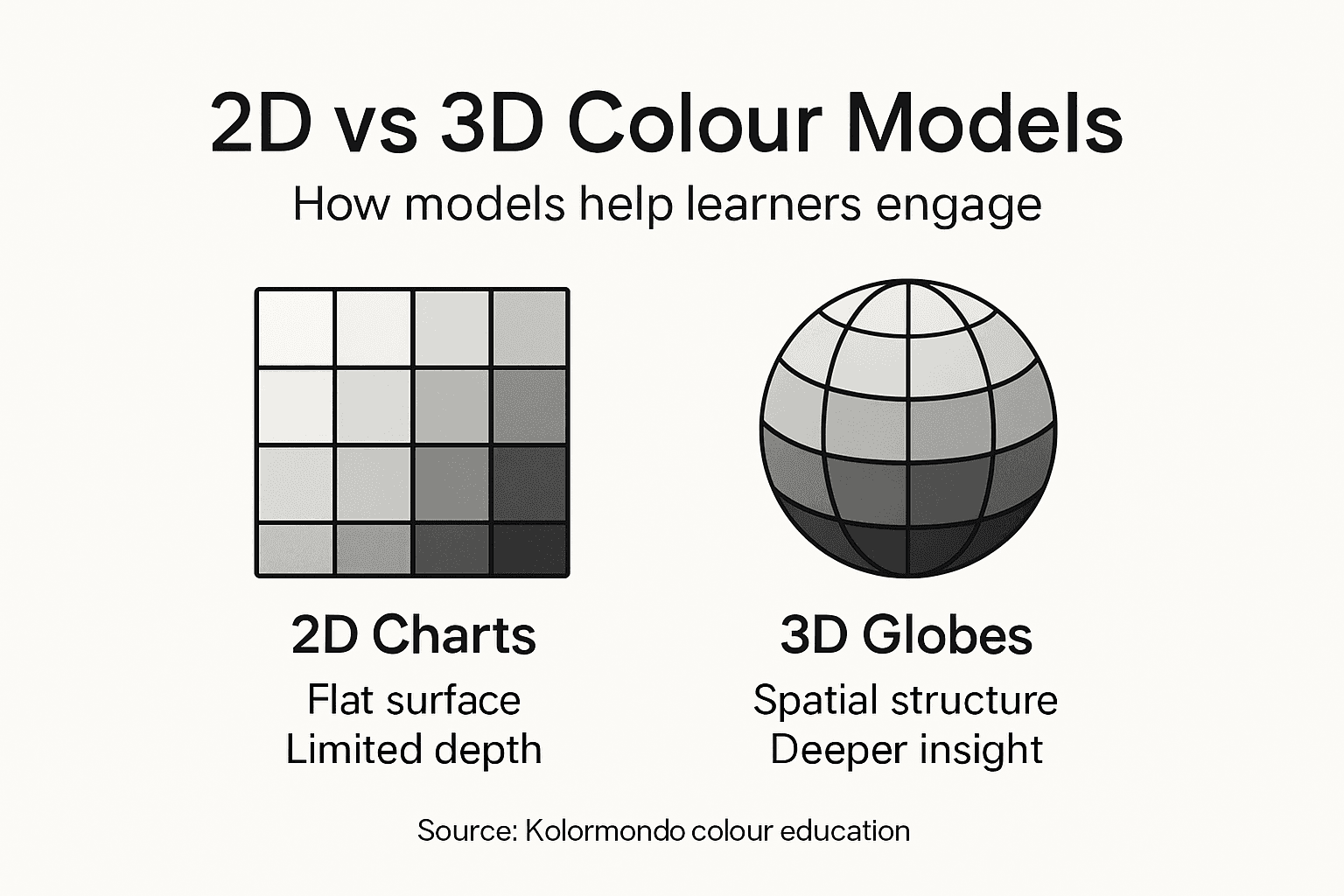
Here’s a comparison of how depth and interactivity impact colour learning with 2D and 3D models:
| Aspect | 2D Colour Charts | 3D Colour Globes |
|---|---|---|
| Depth Perception | Minimal spatial awareness | Realistic spatial understanding |
| Interactivity | Observational, not manipulable | Rotational, tactile engagement |
| Relationship Clarity | Basic chromatic relationships | Complex colour interactions viewed |
| Learning Motivation | Passive participation | Active, multisensory involvement |
Pro tip: Experiment with both 2D and 3D colour models to develop a comprehensive understanding of colour theory and spatial relationships.
Common misconceptions in colour education
Colour education is fraught with persistent myths and oversimplified interpretations that can significantly hinder learners’ understanding of chromatic complexity. Traditional colour theory often neglects perceptual nuances that reveal the intricate nature of human colour perception.
Some of the most prevalent misconceptions in colour education include:
-
Colour as a Static Concept:
- Believing colours have fixed, unchanging properties
- Overlooking contextual and environmental influences
- Ignoring individual perceptual differences
- Treating colour as a purely objective phenomenon
-
Simplified Colour Relationships:
- Assuming linear colour interactions
- Relying exclusively on 2D colour wheel models
- Underestimating psychological and cultural colour associations
- Neglecting the role of light and perception
Educators and learners frequently misunderstand colour as a straightforward, predictable phenomenon. In reality, colour perception is a complex interplay of physiological, psychological, and environmental factors. Colour systems are dynamic, not static, requiring multidimensional approaches to truly comprehend their intricate relationships.
Pro tip: Challenge your existing colour theory assumptions by exploring diverse perspectives and experimental colour learning techniques.
Key features of 3D colour globes
Three-dimensional colour globes represent a revolutionary approach to understanding chromatic relationships, offering a comprehensive and immersive learning experience that transcends traditional two-dimensional representations. Exploring 3D colour globes transforms visual understanding by providing a holistic, spatial perspective on colour interactions.
Key features of 3D colour globes include:
-
Spatial Representation:
- Volumetric spherical configuration
- Full 360-degree colour exploration
- Comprehensive chromatic relationship visualisation
- Depth and dimensionality beyond flat charts
-
Interactive Learning Characteristics:
- Tactile and physical engagement
- Dynamic colour relationship understanding
- Intuitive colour mixing demonstration
- Multimodal sensory learning experience
Colour Globe Structural Elements distinguish these three-dimensional models from traditional flat representations. Unlike 2D colour wheels, 3D globes allow learners to rotate, examine, and interact with colour spaces from multiple angles, revealing nuanced relationships that are impossible to perceive in two-dimensional formats.

Pro tip: Rotate and physically manipulate 3D colour globes to unlock deeper insights into chromatic interactions and spatial colour relationships.
Educational benefits for hands-on learning
Hands-on learning transforms colour education from a passive to an actively engaging experience, enabling students to explore chromatic relationships through direct manipulation and sensory interaction. Interactive 3D colour approaches significantly enhance cognitive processing by providing multidimensional learning opportunities that traditional methods cannot replicate.
Key educational benefits of hands-on colour learning include:
-
Cognitive Development:
- Enhanced spatial understanding
- Improved pattern recognition
- Deeper conceptual comprehension
- More intuitive colour relationship insights
-
Experiential Learning Advantages:
- Active engagement over passive observation
- Increased memory retention
- Personalised learning pathways
- Stimulation of multiple sensory channels
Physical interaction with colour models creates a profound learning experience that transcends traditional instructional methods. Tactile exploration allows learners to understand colour relationships through direct manipulation, transforming abstract concepts into tangible, comprehensible experiences.
Pro tip: Encourage learners to physically rotate and interact with 3D colour models to unlock deeper perceptual understanding.
Comparing 3D globes to traditional charts
Traditional colour charts and 3D colour globes represent fundamentally different approaches to understanding chromatic relationships, each offering distinct advantages and limitations. Exploring colour globe design reveals the profound differences between two-dimensional and three-dimensional colour visualisation methods.
Key comparative characteristics include:
-
Traditional 2D Charts:
- Flat, single-plane representation
- Limited spatial perception
- Static colour relationships
- Linear colour interactions
-
3D Colour Globes:
- Volumetric, multidimensional structure
- Dynamic spatial relationships
- Full 360-degree colour exploration
- Immersive sensory learning experience
Dimensional Representation fundamentally distinguishes these two approaches. While traditional charts compress colour relationships into a single plane, 3D globes allow learners to explore chromatic interactions through depth, rotation, and comprehensive spatial understanding. This three-dimensional perspective enables a more nuanced and intuitive comprehension of colour theory.
Pro tip: Compare multiple visualisation methods to develop a comprehensive understanding of colour relationships and interactions.
Mistakes and pitfalls to avoid in teaching
Understanding complex colour perception challenges requires educators to recognise and address common misconceptions in colour theory instruction. Teaching colour relationships involves navigating nuanced perceptual landscapes that extend far beyond simplistic, linear representations.
Common teaching mistakes include:
-
Conceptual Oversimplification:
- Treating colour as uniform and static
- Ignoring individual perceptual differences
- Relying exclusively on 2D colour charts
- Presenting colour as objective rather than contextual
-
Pedagogical Limitations:
- Avoiding hands-on interactive learning
- Neglecting psychological colour associations
- Failing to explore multidimensional perspectives
- Minimising the role of environmental factors
Effective colour education demands a dynamic approach that embraces complexity. Educators must move beyond rigid, prescriptive models and encourage learners to explore the rich, contextual nature of colour perception through interactive and multisensory experiences.
Below is a summary of common pitfalls and corresponding teaching solutions in colour education:
| Teaching Pitfall | Resulting Issue | Solution Idea |
|---|---|---|
| Overreliance on 2D charts | Limited conceptual depth | Blend 2D and 3D approaches |
| Ignoring perception differences | Student confusion | Adapt to learners’ experiences |
| Neglecting hands-on learning | Weak retention and engagement | Include tactile colour activities |
| Presenting colour as static | Missed contextual complexity | Illustrate colour’s dynamic nature |
Pro tip: Incorporate diverse visualisation methods and encourage students to challenge their existing colour perception assumptions.
Discover the Power of 3D Colour Visualisation with Kolormondo
Struggling to bridge the gap between flat, static colour charts and the vibrant, complex world of real colour relationships The article highlights the limitations of traditional 2D colour wheels and charts and the transformative impact of immersive 3D colour globes on learning. If you want to engage learners with a tactile, multidimensional approach that deepens spatial understanding and sparks active participation explore our Color Globe and color sphere - Kolormondo collection.
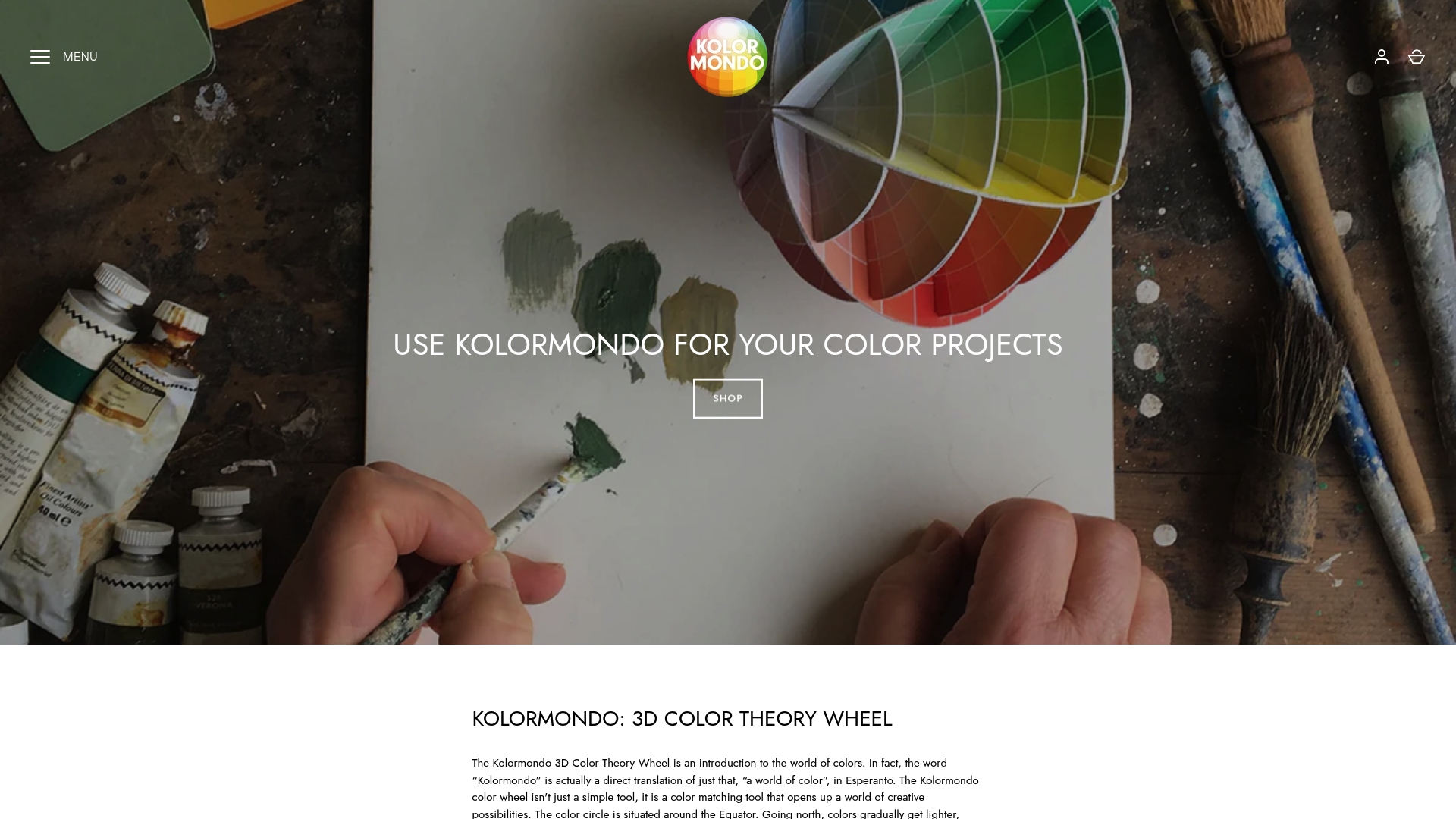
Step up your colour education game now by integrating hands-on 3D globes that facilitate richer cognitive connections and creative exploration. Visit Kolormondo to find innovative tools designed specifically to overcome common teaching pitfalls and elevate your students’ experience. Complement your teaching with ready-made Educational material and lesson plans - Kolormondo and transform passive colour observation into dynamic, interactive discovery.
Frequently Asked Questions
What are the main differences between 2D and 3D colour visualisation?
2D colour visualisation typically presents colours on flat surfaces, limiting spatial perception, while 3D colour visualisation offers a volumetric perspective, allowing for a more immersive and dynamic understanding of colour relationships.
How can 3D colour globes enhance learning compared to traditional 2D colour charts?
3D colour globes allow for tactile engagement and realistic spatial understanding, creating an active learning experience where students can explore complex colour interactions from multiple angles, unlike static 2D charts.
What are some misconceptions about colour education that affect learning?
Common misconceptions include viewing colour as a static concept rather than recognising its dynamic and contextual nature. Many learners also oversimplify colour relationships by relying solely on 2D models without considering perceptual differences.
How does hands-on learning improve the teaching of colour theory?
Hands-on learning fosters greater cognitive development and memory retention by encouraging active participation. It transforms abstract concepts into tangible experiences, allowing learners to grasp complex colour relationships through direct interaction.
Recommended
Find similar articles
3d vs 2d color visualization
