

Most british art education programs still rely on flat colour wheels, yet over 80 percent of students show greater retention when tactile resources are used for colour theory. As understanding chromatic relationships becomes central to creative practice, art educators and university students worldwide are searching for tools that bring theory to life. Exploring how three-dimensional models and hands-on approaches can deepen engagement, this guide highlights practical ways to bridge traditional concepts with modern learning needs.
Table of Contents
- What Is a Colour Wheel in Art Education
- Core Types: Flat, Digital and 3D Models
- Key Features: Colour Mixing and Harmony Tools
- How Colour Wheels Enhance Creative Practice
- Common Pitfalls and 3D Model Advantages
Key Takeaways
| Point | Details |
|---|---|
| Understanding Colour Wheels | Colour wheels are essential tools that organise colours systematically, helping students grasp complex chromatic relationships and principles of colour theory. |
| Types of Colour Wheels | Various models, including flat, digital, and 3D colour wheels, offer unique advantages for teaching and understanding colour mixing and relationships. |
| Colour Harmony Principles | Colour wheels illustrate harmony types, enabling artists to create balanced compositions through the strategic use of complementary, analogous, and monochromatic schemes. |
| Encouraging Creativity | Using colour wheels fosters artistic confidence and encourages experimentation, allowing learners to develop a deeper relationship with colour as a medium of expression. |
What Is a Colour Wheel in Art Education
A colour wheel represents a foundational visual tool that systematically organises colours to help artists and students understand complex chromatic relationships. Exploring colour theory principles allows learners to comprehend how different hues interact, connect, and produce visual harmony through a strategic circular arrangement.
Traditionally, the colour wheel includes primary colours (red, blue, yellow), secondary colours (green, orange, purple), and tertiary colours. This structured representation enables art educators to demonstrate fundamental colour interactions, teaching students about complementary relationships, colour temperature, and visual contrast. By providing a clear, intuitive framework, colour wheels transform abstract colour theory into a tangible learning experience that students can readily understand and apply.
Modern colour wheels have evolved from simple flat diagrams to more sophisticated three-dimensional representations that offer deeper insights into colour relationships. These advanced models help students understand nuanced aspects like saturation, brightness, and chromatic complexity beyond basic colour mixing. Art educators increasingly recognise colour wheels as essential pedagogical tools that bridge theoretical knowledge with practical artistic application.
Pro tip: Practice creating your own colour wheel by mixing primary colours systematically to understand how secondary and tertiary colours emerge through intentional blending.
Core Types: Flat, Digital and 3D Models
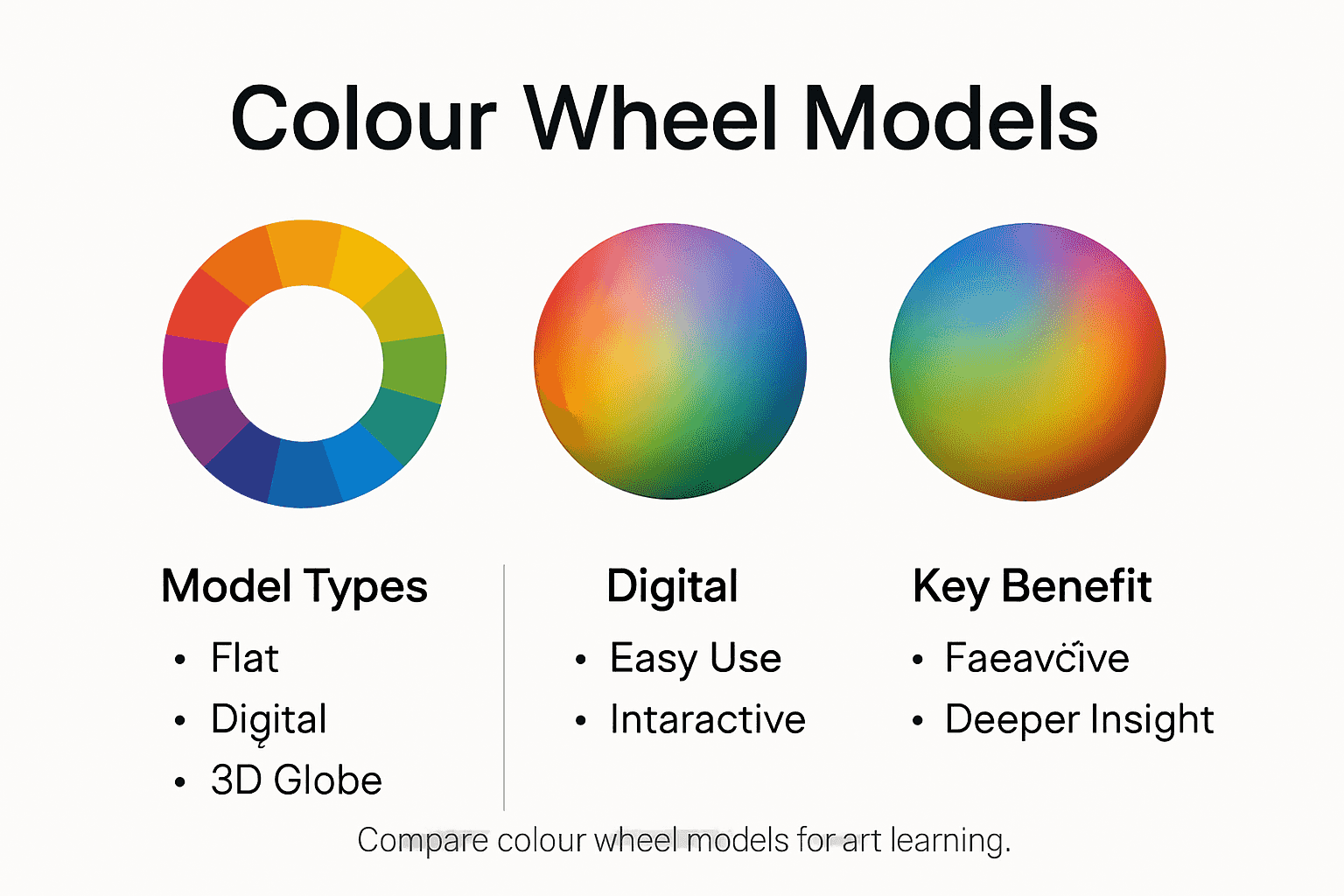
Colour wheel models have significantly evolved, offering art educators diverse approaches to teaching colour theory. The traditional flat colour wheel remains a fundamental educational tool, presenting colours in a straightforward circular arrangement that helps students understand basic chromatic relationships. These classic models typically organise primary, secondary, and tertiary colours in a simple, easily comprehensible format.
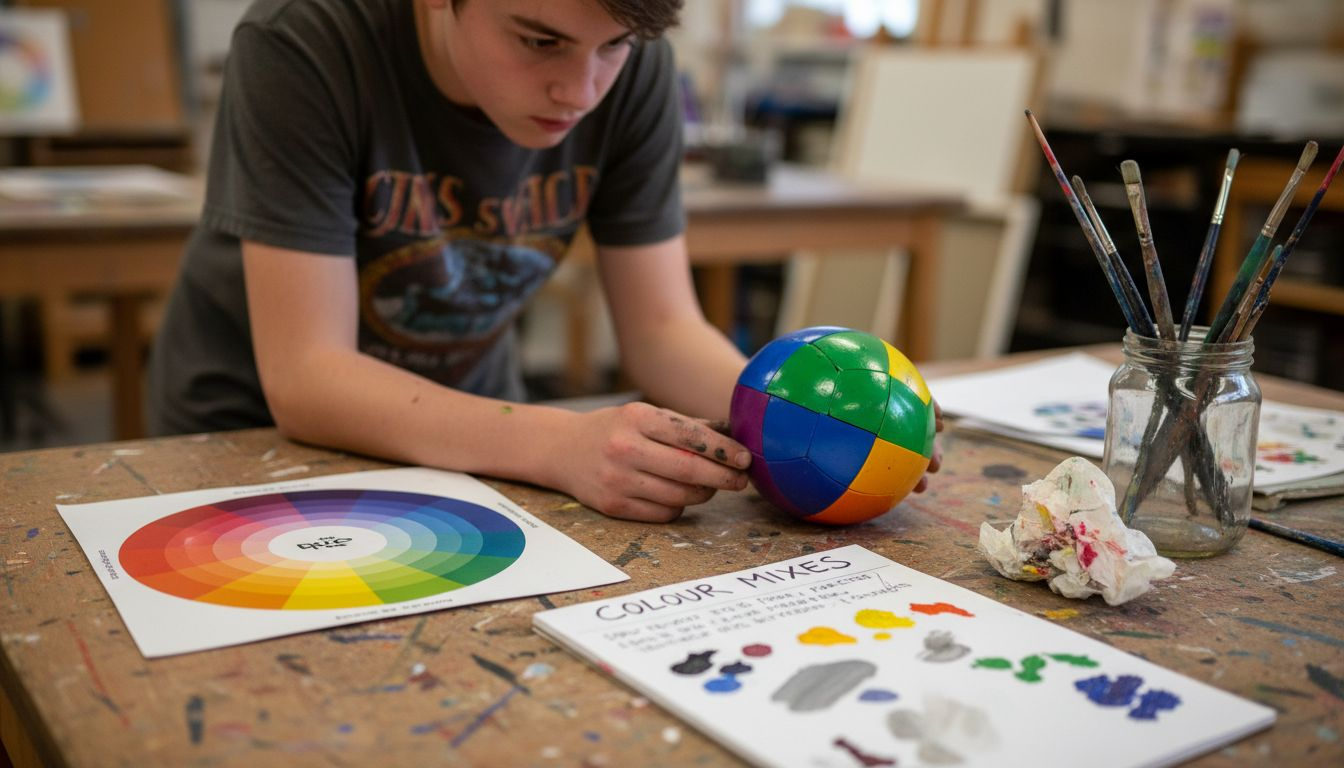
Digital colour wheels represent a modern technological advancement in colour education. These interactive platforms provide dynamic features that enable designers and students to explore complex colour harmonies, generate instant palettes, and experiment with digital colour mixing. Unlike static flat models, digital tools offer real-time calibration, allowing users to manipulate hues, understand complementary relationships, and create sophisticated colour schemes with unprecedented precision.
Three-dimensional colour wheels mark the most innovative approach to colour theory instruction. Visualising colour in 3D transforms traditional two-dimensional representations by introducing depth, volume, and more nuanced colour relationships. These advanced models demonstrate how colours interact across multiple axes, revealing subtle variations in saturation, brightness, and chromatic complexity that flat or digital representations cannot capture. By presenting colours as interconnected spatial entities, 3D models provide a more holistic understanding of colour theory.
Pro tip: Experiment with multiple colour wheel models to develop a comprehensive understanding of colour interactions, combining insights from flat, digital, and three-dimensional representations.
Here is a comparison of key colour wheel models and their educational benefits:
| Model Type | Distinctive Features | Educational Advantages |
|---|---|---|
| Flat | Simple, circular layout | Clear introduction to colour theory |
| Digital | Interactive, instant palettes | Enhances engagement and precision |
| 3D | Depth, volume, complex relations | Reveals chromatic complexity |
Key Features: Colour Mixing and Harmony Tools
Colour wheels serve as sophisticated visual mapping systems that enable artists and educators to understand complex chromatic interactions. Practical colour mixing techniques demonstrate how primary colours can be systematically transformed into secondary and tertiary hues, revealing the intricate relationships between different chromatic families. These tools provide a structured approach to understanding colour generation and transformation.
The most critical feature of colour wheels lies in their ability to illustrate colour harmony principles. Artists can quickly identify complementary, analogous, and monochromatic colour schemes, which are essential for creating visually balanced compositions. Comprehensive colour wheel analysis allows practitioners to explore how colours interact aesthetically, helping them make informed decisions about colour selection and combination in various artistic contexts.
Beyond basic mixing, advanced colour wheels offer nuanced insights into colour temperature, emotional resonance, and visual contrast. They function as comprehensive guides that help artists understand how different hues communicate subtle visual messages. By revealing the complex interactions between colours, these tools transform colour theory from an abstract concept into a practical, applicable skill set that can be readily employed across multiple artistic disciplines.
Pro tip: Practice creating colour palettes by selecting colours from different segments of the colour wheel to develop an intuitive understanding of chromatic relationships.
The following table summarises main colour harmony types and their practical impact for artists:
| Harmony Type | Visual Effect | Artistic Application |
|---|---|---|
| Complementary | Strong contrast | Dynamic, eye-catching compositions |
| Analogous | Gentle, unified look | Calm, harmonious scenes |
| Monochromatic | Subtle variation of tone | Sophisticated, cohesive designs |
How Colour Wheels Enhance Creative Practice
Innovative colour wheel approaches transform art education by providing students with interactive and engaging methods to explore chromatic relationships. These visual tools bridge theoretical knowledge and practical application, enabling learners to develop a nuanced understanding of colour interactions through hands-on experimentation. By encouraging direct manipulation and exploration, colour wheels empower students to move beyond passive learning and actively engage with artistic concepts.
Creative practitioners use colour wheels as strategic instruments for developing sophisticated artistic skills. Artistic colour exploration techniques help artists convey complex emotional landscapes through deliberate colour selection and composition. The wheel becomes a powerful diagnostic tool, allowing creators to understand how different hues communicate mood, tension, and visual harmony. Students learn to make intentional choices about colour temperature, contrast, and complementary relationships, transforming technical understanding into expressive capability.
Beyond technical instruction, colour wheels cultivate artistic confidence by demystifying colour theory’s complex principles. They provide a structured yet flexible framework for understanding how colours interact, communicate, and transform visual experiences. Artists can systematically experiment with different colour combinations, learning to trust their intuitive responses while building a sophisticated technical foundation. This approach encourages creative risk-taking and helps students develop a more profound, personal relationship with colour as a medium of expression.
Pro tip: Create weekly colour mixing challenges using your colour wheel to systematically expand your understanding of chromatic relationships and develop intuitive colour selection skills.
Common Pitfalls and 3D Model Advantages
Colour theory education often suffers from fundamental limitations in traditional learning approaches, particularly when using flat, two-dimensional colour wheels. Advanced colour representation techniques demonstrate how three-dimensional models overcome critical pedagogical challenges by illustrating colour relationships with unprecedented depth and complexity. These innovative models eliminate common misinterpretations that plague traditional flat representations, providing a more nuanced and comprehensive understanding of chromatic interactions.
Traditional colour wheels frequently create misconceptions about colour mixing and relationships by presenting hues in a restricted, linear format. 3D models resolve these limitations by showing colours as interconnected volumetric entities, revealing subtle gradations of saturation, brightness, and temperature that are invisible in two-dimensional formats. This spatial approach enables students and artists to comprehend colour as a multidimensional phenomenon, moving beyond simplistic colour mixing rules to a more sophisticated understanding of chromatic complexity.
The most significant advantage of 3D colour models lies in their ability to demonstrate the intricate, non-linear nature of colour interactions. By representing colours as interconnected spatial elements, these models help learners understand how hues transform and relate to each other across different contexts. This approach challenges the reductive thinking often associated with traditional colour theory, encouraging a more holistic and dynamic perspective on colour as a complex, living system of visual communication.
Pro tip: Experiment with multiple 3D colour models to develop a more nuanced understanding of how colours interact across different dimensions and contexts.
Transform Colour Education with the Kolormondo 3D Colour Globe
Struggling to move beyond flat, two-dimensional colour wheels in your art education practice Because traditional charts often limit understanding of colour interactions and create misconceptions the Kolormondo 3D Colour Globe offers an innovative and tactile solution. This uniquely designed globe visually maps complex chromatic relationships including saturation brightness and hue in a multidimensional way helping educators and students develop a deeper intuitive grasp of colour theory. Explore how hands-on colour exploration inspires confident artistic choices and enriches lesson plans with Educational material and lesson plans - Kolormondo.
Discover the full range of our 3D colour globes and see how this powerful learning tool can transform your creative practise by visiting our Color Globe and color sphere - Kolormondo. Do not miss out on our current opportunities to secure your own with Special offers for colour. Embrace a fresh and comprehensive approach to colour theory today at https://kolormondo.com and make colour learning an engaging and practical experience.
Frequently Asked Questions
What is a colour wheel and how is it used in art education?
A colour wheel is a visual tool that organises colours to help artists understand their relationships. It illustrates primary, secondary, and tertiary colours, aiding in the teaching of colour mixing and harmony principles.
What are the different types of colour wheels available for educational purposes?
There are three main types of colour wheels: flat, digital, and three-dimensional. Flat colour wheels are straightforward and easy to understand, digital colour wheels offer interactivity and instant palettes, while 3D colour wheels provide depth and a more complex understanding of colour relationships.
How do colour wheels facilitate colour mixing and harmony?
Colour wheels illustrate colour mixing techniques, showing how primary colours combine to create secondary and tertiary hues. They also help identify complementary, analogous, and monochromatic colour schemes, crucial for achieving visual balance in compositions.
Why should educators use 3D colour wheels instead of traditional flat models?
3D colour wheels provide a more nuanced understanding of colour relationships by depicting colours as interconnected entities. They overcome limitations of flat models by illustrating saturation, brightness, and temperature variations, enriching the learning experience and helping students grasp complex colour interactions.
Recommended
- Role of Colour Wheels in Teaching Creativity
- 7 Creative Uses for Colour Wheels in Art and Design
- 7 Essential Colour Theory Tips for Educators and Artists
- 7 Key Colour Wheel Comparison List Tips for Art and Design
- Commissions · Personal Yoni Art · Protective Paintings – ART BY SHAKTI
- Golden Wings 1 – ART BY SHAKTI
- Golden Wings 2 – ART BY SHAKTI
Find similar articles
why use color wheels in art
