

Most british students and artists rely on colour wheels without realising their full potential or hidden flaws. Over 90 percent of educators still use traditional two-dimensional colour wheels, unintentionally limiting creative learning. Grasping the difference between outdated tools and modern three-dimensional approaches can transform how we understand colour. This article sheds light on the real power of colour wheels, dispels common myths, and highlights why advanced models matter for anyone serious about visual education.
Table of Contents
- Colour Wheels Defined And Common Misconceptions
- 2D Versus 3D Colour Wheels In Education
- Using Colour Wheels For Visual Learning
- Kolormondo Globe In Hands-On Colour Exploration
- Common Pitfalls With Traditional Colour Tools
Key Takeaways
| Point | Details |
|---|---|
| Colour Wheels as Dynamic Tools | Colour wheels are essential for understanding complex colour relationships, moving beyond static representations to embrace dynamic and multi-dimensional aspects. |
| Shift to 3D Models | Embracing three-dimensional colour wheels enhances comprehension and engagement, allowing for a more holistic view of colour interactions. |
| Importance of Tactile Learning | Interactive models like the Kolormondo Globe facilitate hands-on exploration, significantly improving understanding of colour mixing and harmony. |
| Common Misconceptions | Traditional colour tools often perpetuate simplified views of colour, limiting the understanding of vital aspects such as saturation and value. |
Colour Wheels Defined and Common Misconceptions
A colour wheel represents a fundamental visual tool that helps artists, designers, and students understand complex colour relationships through systematic arrangement. Historically developed to map chromatic connections, these circular diagrams illustrate how different hues interact, blend, and harmonise. Understanding the nuanced role of colour wheels requires moving beyond simplistic perceptions and recognising ongoing colour research developments.
Many learners mistakenly view colour wheels as static, unchanging instruments. However, contemporary colour theory reveals a dynamic landscape where understanding goes far beyond basic colour categorisation. Colour literacy experts emphasise that ‘colour’ involves sophisticated multi-dimensional attributes, not merely surface-level visual perception. A comprehensive colour wheel demonstrates complex interactions between hue, saturation, and brightness, challenging traditional binary thinking about chromatic relationships.
Common misconceptions persist about colour classification. Some individuals incorrectly assume that black and white are not colours, or that hue and colour are synonymous terms. Professional colour theorists recognise these as oversimplified interpretations. A robust colour wheel illuminates subtle gradations, showing how seemingly disparate tones can create harmonious compositions through strategic placement and understanding of complementary, analogous, and triadic colour schemes.
By deconstructing these misconceptions, colour wheels emerge as powerful educational tools. They transform abstract colour theory into tangible, visual learning experiences that empower creative practitioners across disciplines. Whether you are a graphic designer selecting a palette, an interior decorator creating ambience, or an artist exploring emotional resonance through colour, understanding the nuanced mechanics of colour wheels provides a critical foundation for innovative visual expression.
2D Versus 3D Colour Wheels in Education
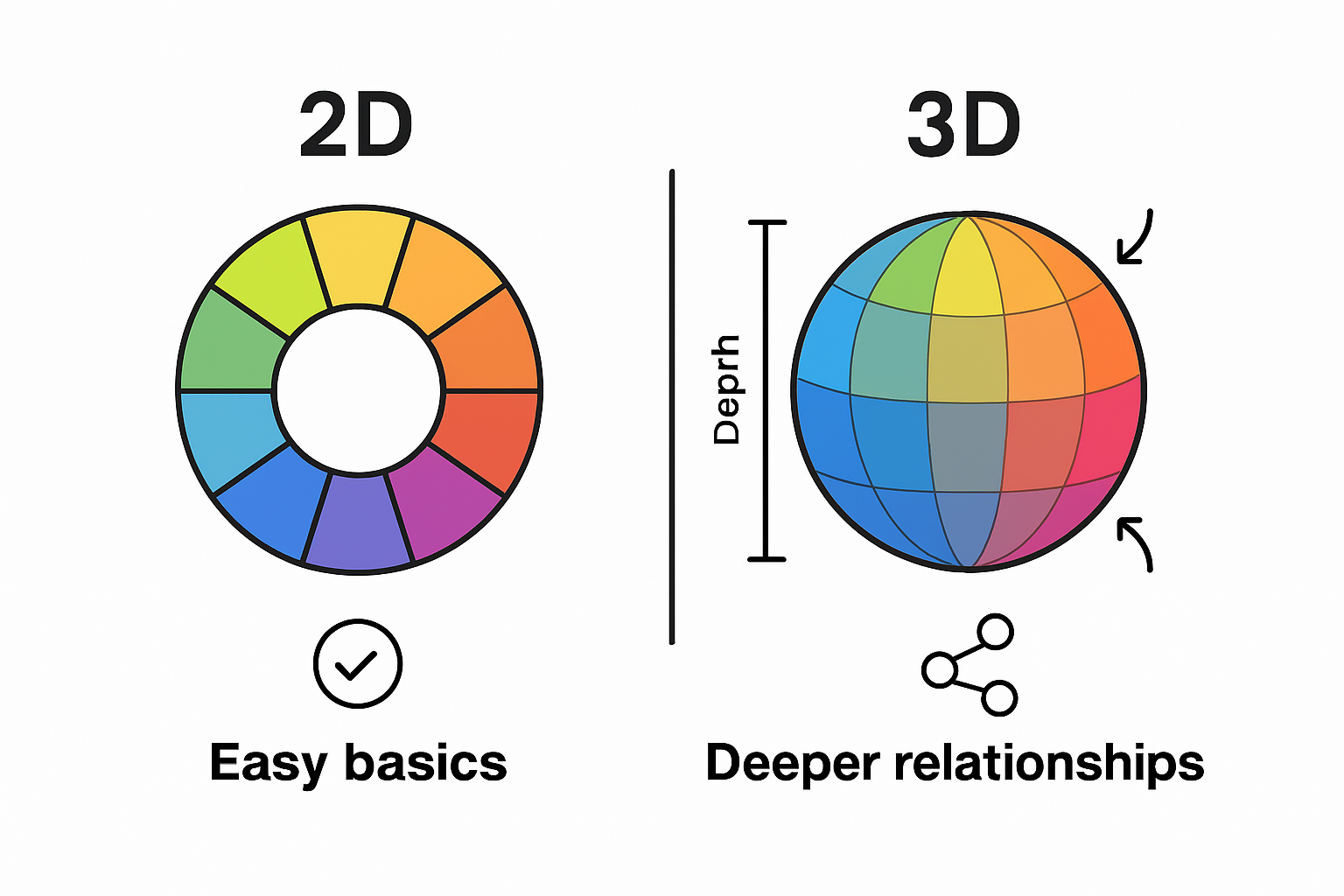
Traditional 2D colour wheels have long been the standard pedagogical tool for teaching colour theory, but emerging research challenges their comprehensive effectiveness. Recent educational studies reveal that 90% of educators continue to rely on two-dimensional colour representations, potentially limiting students’ understanding of colour’s inherent complexity. These flat representations offer a simplified perspective, reducing the multidimensional nature of colour to a circular diagram that fails to capture nuanced chromatic interactions.
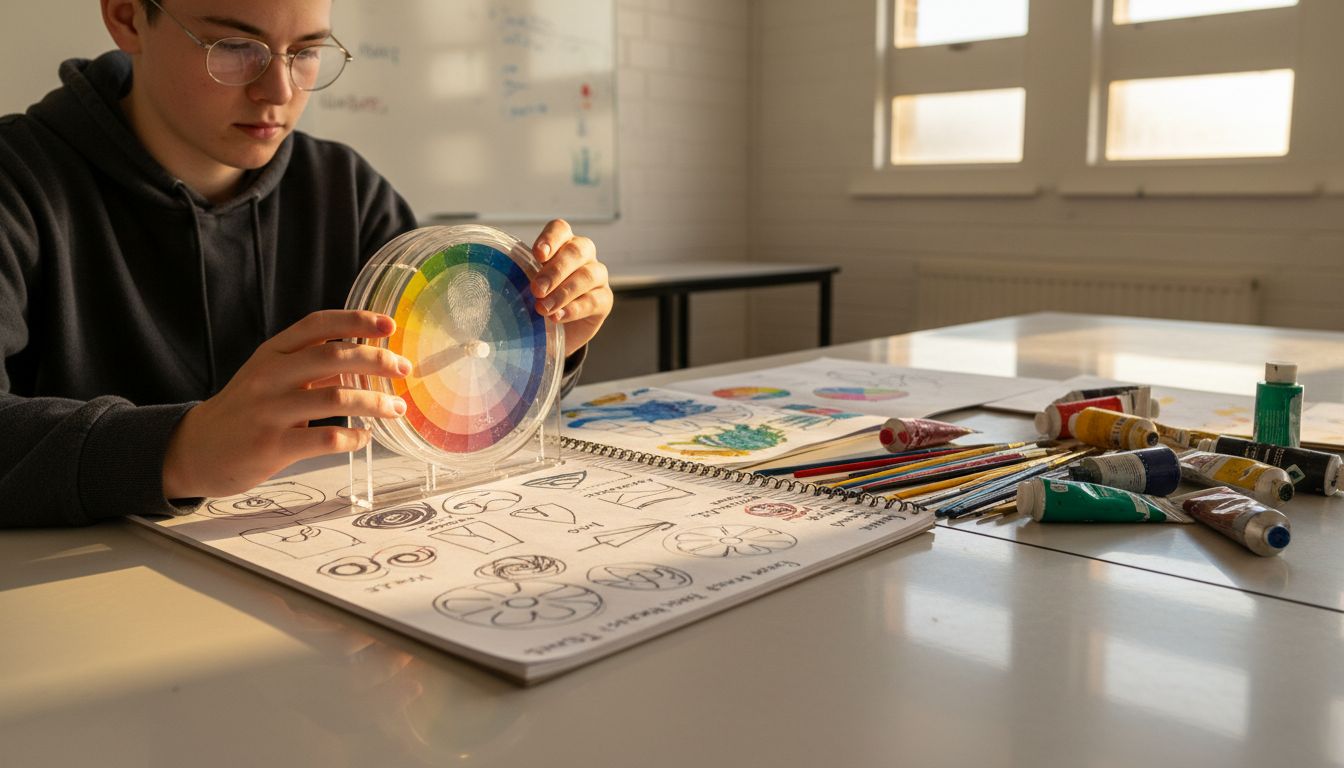
Three-dimensional colour wheels represent a significant pedagogical advancement, providing a more holistic approach to colour education. Innovative design research demonstrates how 3D models can enhance comprehension, particularly for learners struggling with traditional visual representations. By introducing depth, saturation, and brightness as tangible spatial attributes, 3D colour wheels transform abstract colour theory into a more intuitive, engaging learning experience. These models allow students to rotate, examine, and interact with colour relationships in ways impossible with conventional 2D diagrams.
The limitations of 2D colour wheels become particularly evident when exploring advanced colour concepts. Traditional wheels typically focus on hue, neglecting critical dimensions like value and chroma. In contrast, 3D models provide a comprehensive view of colour’s inherent complexity, showing how subtle variations in tone and intensity create rich, nuanced visual experiences. This approach supports more sophisticated understanding across disciplines, from graphic design and fine arts to digital media and colour psychology.
Educators and creative professionals increasingly recognise that understanding colour requires moving beyond simplistic two-dimensional representations. The transition from 2D to 3D colour wheels represents more than a technological upgrade - it signifies a fundamental shift in how we conceptualise and teach colour theory. By embracing three-dimensional models, we can provide learners with more dynamic, interactive tools that reflect the true complexity of colour perception and creative expression.
Using Colour Wheels for Visual Learning
Colour wheels serve as powerful visual learning tools that transform abstract chromatic relationships into tangible, comprehensible systems. Educational research suggests that colour-coded visual representations can significantly enhance student engagement and learning outcomes, demonstrating their potential beyond mere decorative function. By providing a structured, systematic approach to understanding colour interactions, these tools enable learners to grasp complex visual concepts through intuitive, spatial arrangements.
Interactive visual representations fundamentally alter spatial visualization skills and cognitive processing, making colour wheels particularly effective for visual learners. These instruments break down intricate colour relationships into digestible, memorable patterns. Students can quickly understand complementary colours, colour harmony, and chromatic progression by observing the wheel’s strategic design. This visual mapping allows instant comprehension of relationships that might take extensive textual explanation to communicate.
The pedagogical strength of colour wheels lies in their ability to translate theoretical concepts into practical visual language. Artists, designers, and students can use these tools to explore colour mixing, understand tonal variations, and develop sophisticated colour selection strategies. By presenting colour as an interconnected system rather than isolated elements, colour wheels encourage creative thinking and experimental approaches to visual composition.
Moreover, comprehensive colour theory aids offer sophisticated approaches to understanding chromatic relationships, enabling learners to move beyond simplistic colour application. The wheel becomes more than a reference tool - it transforms into a gateway for exploring creative potential, encouraging users to experiment, challenge preconceptions, and develop a nuanced understanding of visual communication through colour.
Kolormondo Globe in Hands-On Colour Exploration
Innovative three-dimensional colour models offer transformative approaches to tactile learning, providing students and professionals with unprecedented opportunities for direct, immersive colour exploration. The Kolormondo Globe represents a breakthrough in hands-on colour education, moving beyond traditional flat colour wheels by enabling users to physically interact with and manipulate chromatic relationships. This three-dimensional approach allows learners to rotate, examine, and intuitively understand colour interactions from multiple perspectives.
The significance of tactile learning tools cannot be overstated. Research into tactile materials demonstrates how three-dimensional models can dramatically enhance educational experiences, particularly for individuals with diverse learning needs. The Kolormondo Globe transforms colour theory from an abstract concept into a tangible, interactive experience. By providing a spherical representation that can be held, turned, and closely examined, the globe enables users to comprehend colour relationships through direct sensory engagement.
Hands-on exploration with the Kolormondo Globe offers multiple learning advantages. Students can physically trace colour gradations, understand spatial relationships between hues, and develop a more intuitive sense of colour mixing and harmony. The three-dimensional design allows for immediate visualization of how colours interact, blend, and contrast in ways that traditional two-dimensional colour wheels cannot replicate. This approach supports kinesthetic learning styles, encouraging active participation and deeper understanding.
Morever, the comprehensive design of colour reference tools continues to evolve, reflecting growing recognition of the importance of interactive, multisensory educational approaches. The Kolormondo Globe serves not just as an educational instrument, but as a catalyst for creative exploration, inviting users to challenge their preconceptions about colour and discover new possibilities in visual communication.
Common Pitfalls with Traditional Colour Tools
Contemporary colour education research reveals significant limitations in traditional colour tools, highlighting critical gaps in how colour relationships are traditionally presented. Standard two-dimensional colour wheels represent an oversimplified approach that fails to capture the nuanced complexity of chromatic interactions. These flat representations typically reduce colour to a single plane, obscuring critical spatial and perceptual dimensions that are essential for comprehensive understanding.
Traditional colour tools often perpetuate fundamental misconceptions about colour theory, creating substantial barriers to genuine creative understanding. The primary issue lies in reducing colour to a simplistic concept of hue, neglecting the multidimensional nature of colour perception. Students and professionals using these limited tools frequently misunderstand critical aspects such as saturation, value, and the intricate relationships between different chromatic elements.
The most profound limitation of traditional colour wheels is their inability to represent the dynamic, contextual nature of colour. These static representations fail to demonstrate how colours interact under different lighting conditions, within various visual contexts, or across different media. By presenting colour as a fixed, rigid concept, these tools inadvertently restrict creative thinking and limit students’ ability to explore colour’s true expressive potential.
Moreover, contemporary design approaches demand more sophisticated colour understanding, requiring tools that can adapt to complex creative challenges. The evolution of digital design, multimedia production, and cross-disciplinary artistic practices necessitates colour tools that can represent the full spectrum of chromatic complexity. Traditional flat colour wheels simply cannot meet these increasingly sophisticated educational and professional requirements.
Transform Creative Learning with the Kolormondo Globe
The challenge of teaching creativity through traditional flat colour wheels leaves many students and educators struggling to grasp the full complexity of colour relationships. This article highlights common pain points such as limited understanding of hue, saturation, and brightness, and how conventional 2D tools fail to capture the rich, multidimensional nature of colour theory. With the Kolormondo Globe, a pioneering 3D colour wheel, you can overcome these obstacles by bringing colour theory to life through tactile, hands-on exploration. This innovative tool supports deeper learning and sparks genuine creative confidence for artists, designers, and educators alike.
Discover how the Kolormondo Globe offers a practical solution to bridging theory and practice. It allows you to rotate, examine, and interact with colours spatially, making abstract concepts intuitive and memorable. Elevate your teaching methods or fuel your creative projects by including this versatile, spherical colour reference in your toolkit.
Explore our full range of Kolormondo colour globes Color Globe and color sphere - Kolormondo alongside specially designed educational resources at Educational material and lesson plans - Kolormondo.
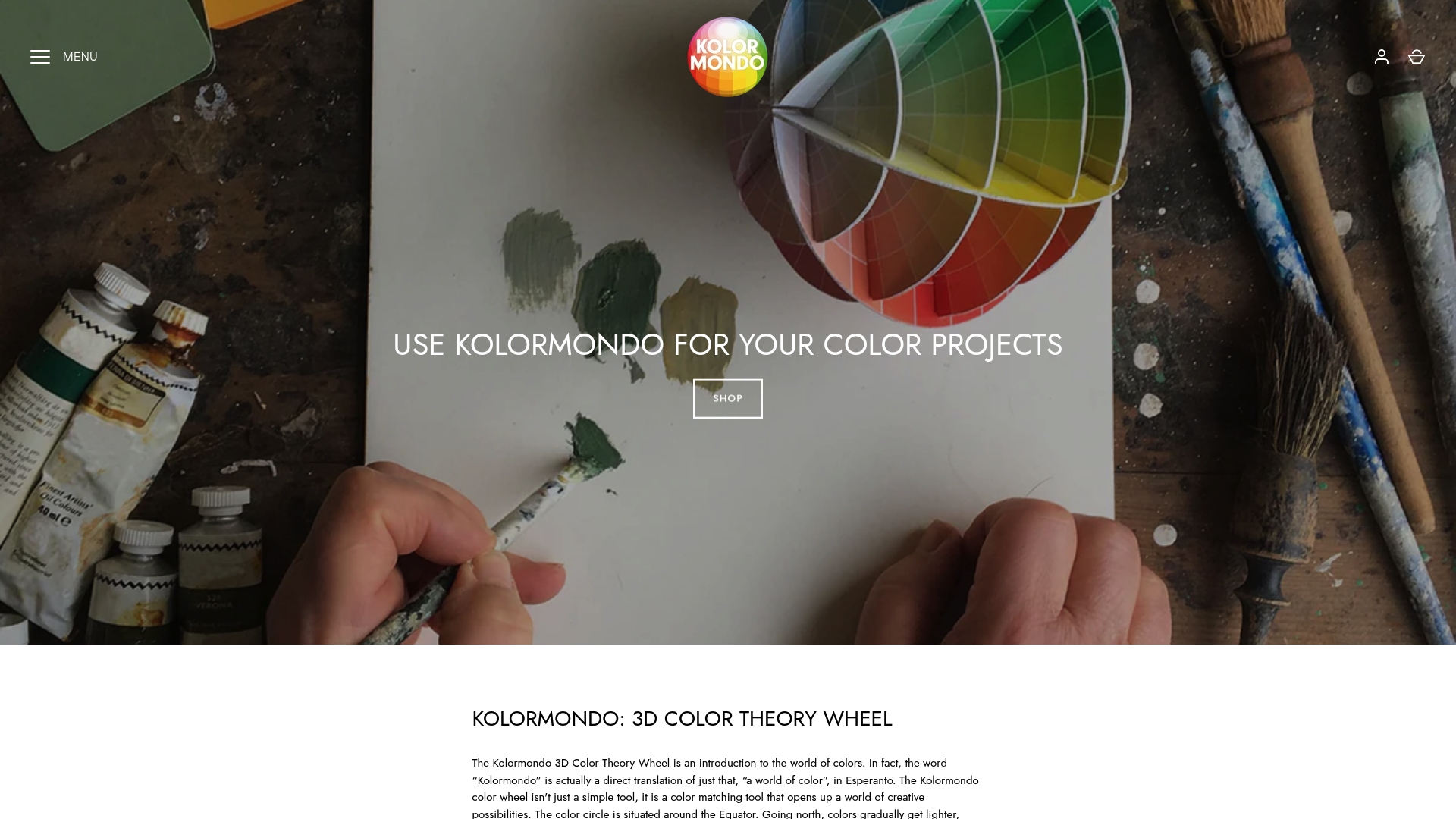
Ready to revolutionise your approach to colour education and creative exploration Visit Kolormondo.com today and bring vibrant three-dimensional colour theory into your learning environment or studio. Start engaging with colour in a new, dynamic way that truly ignites creativity. Order now and experience immediate benefits in understanding and applying colour concepts.
Frequently Asked Questions
What is a colour wheel and how does it help with creativity?
A colour wheel is a visual tool that represents the relationships between different colours, helping artists and designers understand how colours interact. It fosters creativity by providing a structured framework for exploring colour combinations, harmonies, and contrasts in various artistic projects.
How do 2D and 3D colour wheels differ in their teaching effectiveness?
2D colour wheels offer a simplified view of colour relationships, while 3D colour wheels provide a more comprehensive understanding by introducing dimensions such as saturation and brightness. Research shows that 3D models enhance learning by enabling interactive exploration of colour dynamics.
What are common misconceptions about colour that colour wheels can address?
Many learners mistakenly consider colours like black and white as non-colours or equate hue with colour. Colour wheels clarify these points by illustrating the complexity and subtle gradations in colour, helping users grasp the multi-dimensional nature of colour perception.
How can colour wheels be used to improve visual learning?
Colour wheels transform abstract concepts of colour relationships into visual, understandable formats. They help learners connect with colour theory through interactive and structured representations, promoting engagement and facilitating a deeper understanding of colour mixing and harmony.
Recommended
Find similar articles
role of color wheels in teaching
