
Most traditional art classrooms in North America overlook a surprising fact: nearly 60 percent of students cling to outdated colour myths, a problem shared across British and American schools. This makes teaching core colour theory concepts a challenge for art and design educators striving to move beyond textbook models. With hands-on tools like the Kolormondo globe, you can create interactive lessons that help students truly grasp the science and artistry behind colour, breaking free from misconceptions and engaging every learner.
Table of Contents
- Defining Colour Theory And Core Concepts
- Traditional Learning Barriers And Misconceptions
- Types Of Colour Models And Their Distinctions
- Practical Problems In Classroom Colour Teaching
- Hands-On Tools And Kolormondo Globe Solutions
- Avoiding Common Errors And Improving Engagement
Key Takeaways
| Point | Details |
|---|---|
| Understanding Colour Theory | Colour theory is a multidisciplinary field that covers how colours are perceived and utilised across various domains, providing vital frameworks for artistic and design education. |
| Challenging Misconceptions | Traditional colour theory misconceptions can hinder student understanding; educators should adopt holistic, interdisciplinary teaching strategies to address these barriers. |
| Exploring Colour Models | Familiarity with different colour models—additive, subtractive, and perceptual—is essential for effective application in design and scientific contexts. |
| Engaging Learning Approaches | Implementing hands-on and interactive methods in colour education will enhance student comprehension and foster a deeper appreciation of colour principles. |
Defining Colour Theory and Core Concepts
Colour theory represents a complex, multidisciplinary approach to understanding how humans perceive, interact with, and utilise colour across artistic, scientific, and philosophical domains. Colour theory has developed over centuries, emerging as a sophisticated field that bridges visual perception, design principles, and cultural interpretation.
At its core, colour theory explores how colours interact, combine, and communicate visual information. It encompasses multiple critical components including colour ontology, mixing principles, harmony relationships, and psychological meanings. Influential researchers like Michel Chevreul, Albert Munsell, Johannes Itten, and Josef Albers have significantly contributed to developing systematic approaches for understanding colour interactions and perceptual dynamics.
Traditionally taught in art and design programmes, colour theory provides a structured framework for understanding visual communication. The interdisciplinary nature of colour theory means educators must integrate perspectives from psychology, physics, art, and design to provide comprehensive learning experiences. This approach helps students comprehend colour not merely as a visual element, but as a complex system of communication and expression.
Pro tip: Encourage students to experiment with physical colour models and interactive tools to transform abstract colour theory concepts into tangible learning experiences.
Traditional Learning Barriers and Misconceptions
Traditional colour theory misconceptions pose significant challenges in art and design education, creating deep-rooted obstacles that prevent students from developing a nuanced understanding of colour principles. These naive conceptions, often acquired through everyday experiences, act as cognitive barriers that distort students’ perception and comprehension of complex colour interactions.
Students frequently struggle with oversimplified colour concepts that fail to capture the intricate scientific and artistic dimensions of colour theory. Primary colour myths represent a prime example, where learners develop rigid, context-independent beliefs about colour relationships. These misconceptions emerge from limited exposure to comprehensive colour education, leading to a fragmented understanding that persists across different educational levels.
Colour theory oversimplifications have profound implications for learning, particularly when traditional teaching approaches rely on outdated or incomplete models. Modern educators must challenge these ingrained beliefs by introducing more holistic, interdisciplinary approaches that integrate scientific principles with experiential learning techniques. This means moving beyond static colour wheel demonstrations and encouraging students to explore colour’s dynamic, contextual nature across multiple disciplines.
Pro tip: Design interactive learning experiences that deliberately challenge students’ existing colour misconceptions by presenting unexpected colour interactions and scientific explanations.
Types of Colour Models and Their Distinctions
Colour models represent sophisticated systems for understanding and representing colour across various disciplines, each designed to capture unique aspects of colour perception and reproduction. These numerical systems translate complex visual experiences into precise mathematical representations, enabling professionals in design, digital media, printing, and scientific research to communicate and manipulate colour with exceptional accuracy.
The primary colour models can be categorised into three fundamental types: additive, subtractive, and perceptual models. Additive models like RGB (Red, Green, Blue) are predominantly used in digital displays, creating colours by combining light wavelengths. Subtractive models such as CMYK (Cyan, Magenta, Yellow, Key/Black) are essential in printing processes, where colours are created by absorbing specific light wavelengths. Perceptual models, including LMS and CIELAB, aim to mathematically represent human colour perception more accurately.
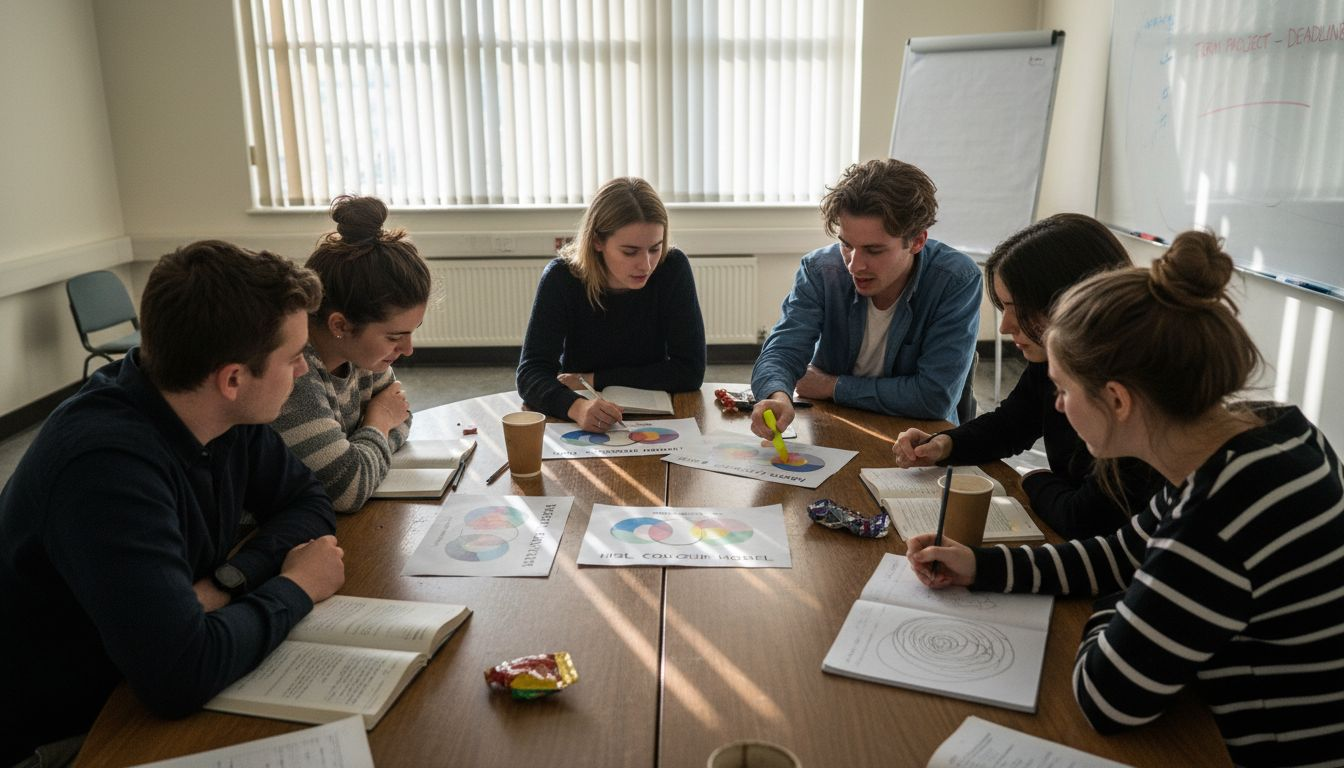
Comprehensive comparisons of colour models reveal intricate differences in how they capture hue, saturation, and lightness. Each model serves distinct purposes: RGB for digital screens, CMYK for print media, HSV for colour selection interfaces, and CIELAB for scientific colour analysis. Understanding these nuanced differences helps professionals select the most appropriate model for their specific application, whether in image processing, graphic design, or scientific research.
To clarify the distinctions among major colour models, here is a concise comparison:
| Colour Model | Main Application | Colour Creation Method | Notable Strength |
|---|---|---|---|
| RGB | Digital screens | Combines red, green, blue light | Vibrant digital colours |
| CMYK | Printing | Overlays coloured inks | Accurate print reproduction |
| HSV | Colour selection tools | Varies hue, saturation, value | Intuitive colour picking |
| CIELAB | Scientific analysis | Mathematical model of perception | Precise visual comparisons |
Pro tip: Encourage students to experiment with multiple colour models, creating practical exercises that demonstrate how different models represent the same colour differently.
Practical Problems in Classroom Colour Teaching
Challenges in art education’s colour instruction reveal significant gaps between theoretical knowledge and practical application, particularly in primary and secondary school settings. Educators frequently encounter students struggling to translate colour theory concepts into meaningful artistic expression, with many learners experiencing difficulty understanding complex colour relationships and interaction principles.
The fundamental issues stem from traditional teaching methodologies that rely heavily on abstract explanations rather than hands-on, experiential learning. Colour perception skills require nuanced development, which static textbook approaches often fail to address. Students typically struggle with understanding subtle colour gradations, mixing techniques, and the psychological implications of colour choices, leading to disorganised and inconsistent colour application in their artistic work.
Classroom environmental factors also play a crucial role in colour learning effectiveness. Research demonstrates that lighting conditions, classroom colour schemes, and visual stimuli can significantly impact students’ cognitive processing and emotional engagement with colour theory concepts. Innovative educators are increasingly recognising the need to create dynamic, multisensory learning environments that support more intuitive colour understanding.
Pro tip: Implement multi-modal colour learning strategies that combine visual demonstrations, tactile colour mixing exercises, and digital interactive tools to address diverse learning styles and enhance students’ colour comprehension.
Hands-On Tools and Kolormondo Globe Solutions
Hands-on learning tools transform colour theory education by providing tangible, interactive experiences that bridge the gap between abstract concepts and practical understanding. Traditional two-dimensional colour representations often fail to capture the complex spatial relationships between colours, limiting students’ ability to comprehend colour interactions comprehensively.
Three-dimensional colour models offer a revolutionary approach to understanding colour theory, enabling learners to explore colour relationships through tactile and visual engagement. These tools allow educators to demonstrate how colours interact, shift, and influence each other in ways that flat charts cannot communicate. By providing a physical, manipulable representation of colour space, such models help students develop a more intuitive and nuanced understanding of colour theory’s fundamental principles.
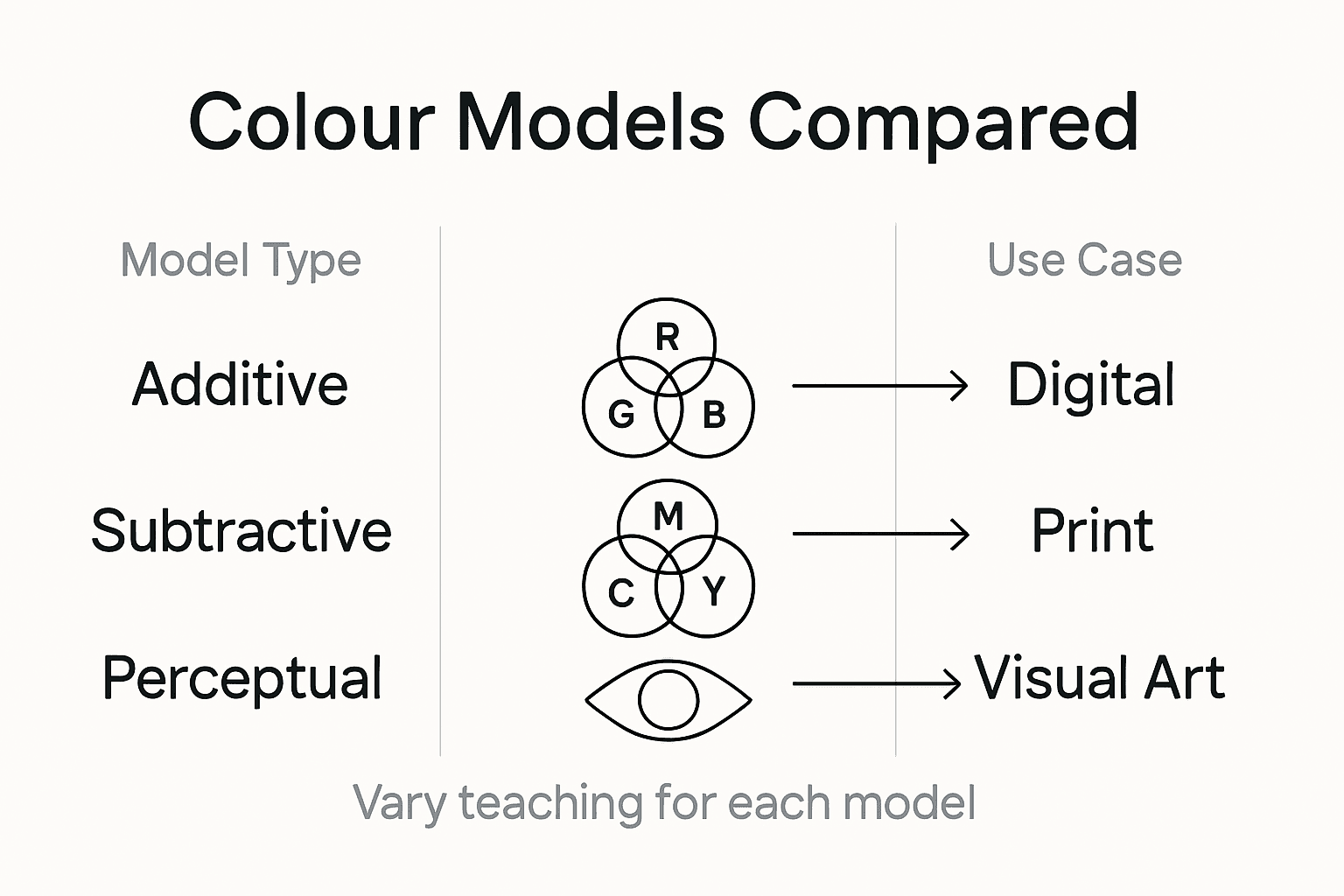
The emergence of innovative educational tools like three-dimensional colour globes represents a significant advancement in colour theory pedagogy. These models enable students to explore colour transitions, understand complementary relationships, and visualise colour gradations with unprecedented clarity. By transforming colour theory from an abstract concept into a tangible, interactive experience, educators can more effectively communicate complex colour principles, making learning more engaging and accessible for students across various disciplines.
Pro tip: Incorporate multisensory colour learning experiences that combine physical models, digital simulations, and hands-on mixing exercises to cater to diverse learning styles and enhance students’ colour comprehension.
Avoiding Common Errors and Improving Engagement
Addressing fundamental misconceptions in colour education requires a strategic approach that challenges traditional, oversimplified teaching methods. Educators must recognise that students often enter classrooms with deeply ingrained, incorrect assumptions about colour relationships, perception, and application, which can significantly impede their learning and creative potential.
The most critical errors emerge from rigid, context-independent colour theories that fail to acknowledge the dynamic and contextual nature of colour perception. Colour understanding demands a nuanced approach that transcends simplistic colour wheel models and fixed primary colour concepts. By introducing more sophisticated, scientifically grounded perspectives, educators can help students develop a more flexible and sophisticated understanding of colour interactions, moving beyond mechanical memorisation towards genuine comprehension.
Human-centred colour education strategies emphasise practical skills, cultural sensitivity, and contextual learning. This approach recognises that colour perception is not universal but deeply influenced by individual experiences, cultural backgrounds, and psychological factors. Successful teaching requires creating learning environments that encourage experimentation, challenge preconceived notions, and connect colour theory to real-world design and artistic applications.
Here is a summary of key strategies for overcoming common colour theory barriers in education:
| Challenge | Effective Strategy | Intended Outcome |
|---|---|---|
| Rigid colour myths | Promote experimental exercises | Flexible conceptual understanding |
| Abstract theoretical instruction | Use hands-on and visual tools | Improved practical application |
| Static classroom environments | Integrate multi-sensory learning | Deeper emotional engagement |
| Cultural assumptions | Encourage diverse perspectives | Greater cultural sensitivity |
Pro tip: Design collaborative colour exploration exercises that encourage students to challenge their existing colour assumptions and share diverse perspectives on colour perception and meaning.
Overcome Colour Theory Challenges with Innovative Tools from Kolormondo
Many educators find it difficult to bridge the gap between abstract colour theory concepts and practical student understanding. This article highlights how traditional methods often leave learners confused by rigid ideas and limited hands-on experience in exploring complex colour relationships. If you seek to engage students more deeply by replacing oversimplified colour wheels with interactive, multisensory tools, this is the solution you need.
Discover the Kolormondo globe, a pioneering 3D colour model that transforms teaching by offering a tactile and visual way to explore colour harmony, gradations, and interactions in a way that flat charts cannot match. Designed especially for educators, artists, and designers, the globe encourages experimentation and helps break down misconceptions with a hands-on approach.
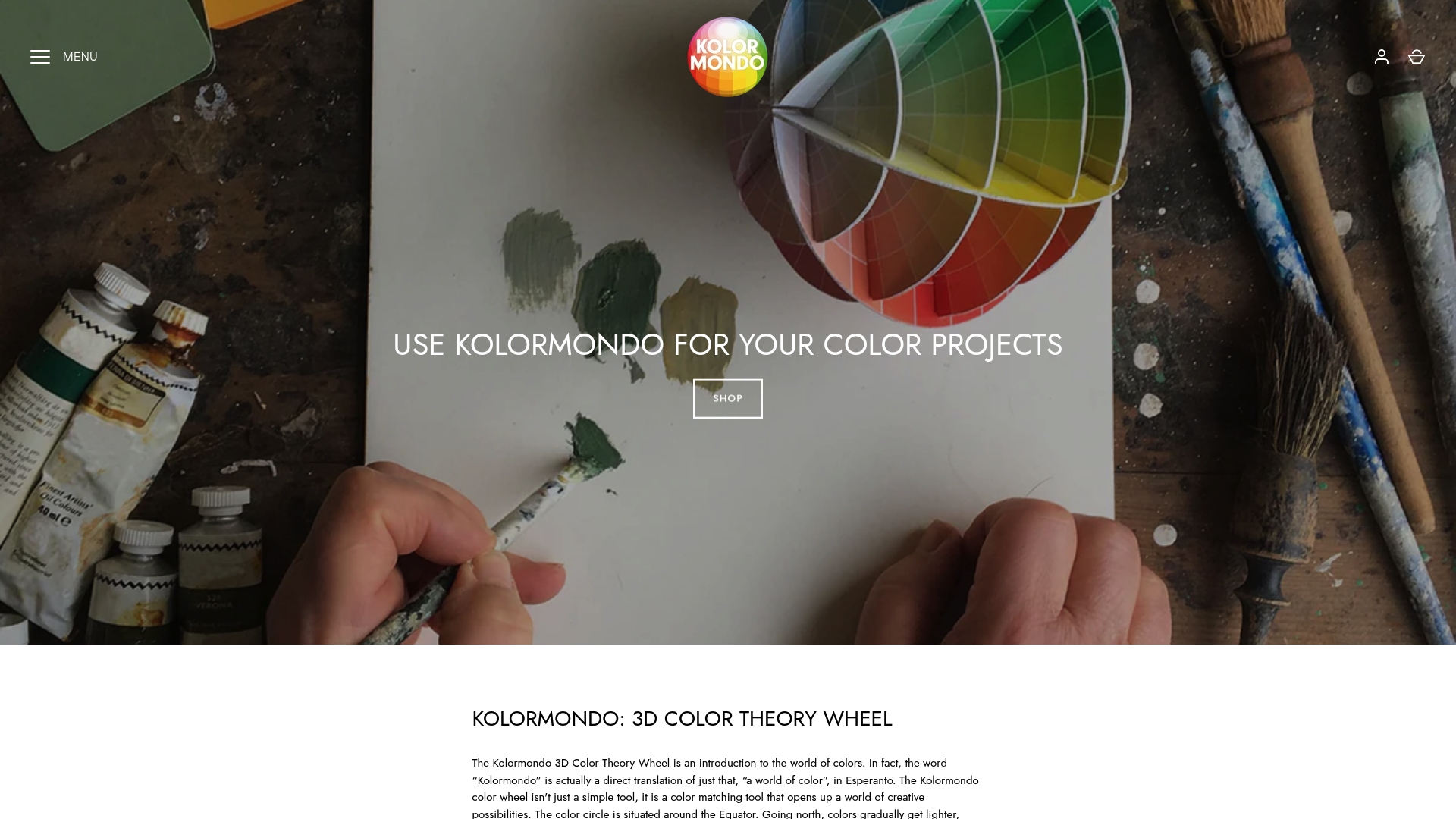
Explore our Educational material and lesson plans - Kolormondo to find ready-to-use resources that complement the globe and foster practical learning. Join upcoming Lectures and Workshops about color - Kolormondo for expert guidance on integrating advanced colour concepts in your teaching. Do not wait to revolutionise your classroom experience and empower your students’ creativity — visit https://kolormondo.com today and see how the Kolormondo globe can reshape your approach to colour education.
Frequently Asked Questions
What are common misconceptions about colour theory in education?
Many students hold oversimplified views of colour relationships, such as rigid beliefs about primary colours. These naive conceptions can hinder their understanding of more complex colour interactions.
How can educators effectively teach colour theory?
Educators can use hands-on, interactive learning tools and encourage experimentation with colour models. Incorporating multisensory experiences enhances students’ understanding by connecting theory to practical application.
What types of colour models should be introduced in the classroom?
Educators should introduce additive models like RGB for digital applications, subtractive models such as CMYK for print, and perceptual models like CIELAB for scientific analysis to provide a comprehensive understanding of colour.
How can classroom environments impact the learning of colour theory?
Lighting conditions, classroom colour schemes, and visual stimuli significantly affect students’ cognitive processing and emotional engagement with colour concepts, making it essential to create dynamic, supportive environments.
Recommended
Find similar articles
challenges in learning color theory
