

Every british artist or designer striving for richer creativity knows that mastering colour theory can quickly become confusing when it comes to three dimensional visualisation. With more than 60 percent of creative professionals reporting challenges in interpreting 3D colour spaces, the right tools and strategies make a world of difference. This guide walks you through practical steps to move beyond flat colour charts, helping you bring spatial colour understanding to life using both physical and digital resources.
Table of Contents
- Step 1: Gather Essential 3D Colour Visualisation Tools
- Step 2: Set Up Your Kolormondo Globe For Exploration
- Step 3: Identify Primary, Secondary And Tertiary Colour Positions
- Step 4: Explore Hue, Value And Chroma With The Globe
- Step 5: Verify Understanding By Testing Colour Relationships
Quick Summary
| Key Insight | Explanation |
|---|---|
| 1. Gather essential 3D tools | Use physical tools like the Kolormondo globe and digital software to explore colour in three dimensions. |
| 2. Set up your Kolormondo globe | Position the globe at eye level in stable lighting for optimal colour observation and interaction. |
| 3. Identify colour relationships | Locate primary, secondary, and tertiary colours to understand their spatial relationships and interactions. |
| 4. Explore hue, value, and chroma | Rotate the globe to observe how different colours shift in hue, value, and intensity across dimensions. |
| 5. Test colour relationships | Perform active experiments to confirm your understanding of colour interactions and document your findings. |
Step 1: Gather essential 3D colour visualisation tools
To successfully visualise colour in three dimensional space, you will need specialised equipment and digital resources that transform traditional colour theory into spatial experiences. Your toolkit should blend physical and digital approaches, enabling rich understanding of chromatic relationships.
Start by exploring both physical and digital tools. Physical options include three-dimensional colour wheels like the Kolormondo globe, which provides tactile colour mapping. For digital solutions, consider open-source 3D graphics software like Art of Illusion, which offers comprehensive modeling and rendering capabilities for designers and artists. Advanced practitioners might investigate Artifact-Based Rendering frameworks that create expressive visualisations through innovative computational techniques.
When selecting your tools, prioritise resources that help you understand colour interactions across multiple dimensions. Seek platforms that allow rotation, colour mixing, and comparative analysis. A well-curated toolkit will transform abstract colour theory into tangible spatial understanding, enabling more nuanced artistic and design projects.
Step 2: Set up your Kolormondo globe for exploration
Unveiling the potential of a three dimensional colour representation requires thoughtful setup and strategic positioning. Your Kolormondo globe represents a powerful tool for understanding colour relationships in a spatial context, offering designers and artists an innovative approach to chromatic exploration.
Begin by selecting a stable surface with consistent lighting that allows full rotation of your colour globe. Position the globe at eye level to facilitate comprehensive viewing and ensure you can observe colour interactions from multiple angles. Adjust the lighting to minimise glare while providing enough illumination to appreciate subtle colour nuances.
As you prepare to explore, consider how the three dimensional format differs from traditional two dimensional colour wheels. The globe enables you to understand colour progression, saturation, and relationship in ways flat charts cannot. Rotate the sphere slowly, observing how colours blend, contrast, and interact across different spatial perspectives. Your careful setup transforms this tool from a mere visual reference into a dynamic learning instrument for artistic and design projects.
Step 3: Identify primary, secondary and tertiary colour positions
Navigating the intricate landscape of colour requires understanding the fundamental relationships between primary, secondary, and tertiary colours. Your Kolormondo globe provides an exceptional three dimensional canvas for exploring these chromatic connections with unprecedented clarity.
Begin by locating the primary colours red, blue, and yellow at equidistant points around the globe. These foundational hues serve as anchor points from which all other colours emerge. Secondary colours green, orange, and purple occupy the midpoints between primary colours, created through precise mixing. Your colour wheel blending strategy becomes crucial in understanding these nuanced transitions.
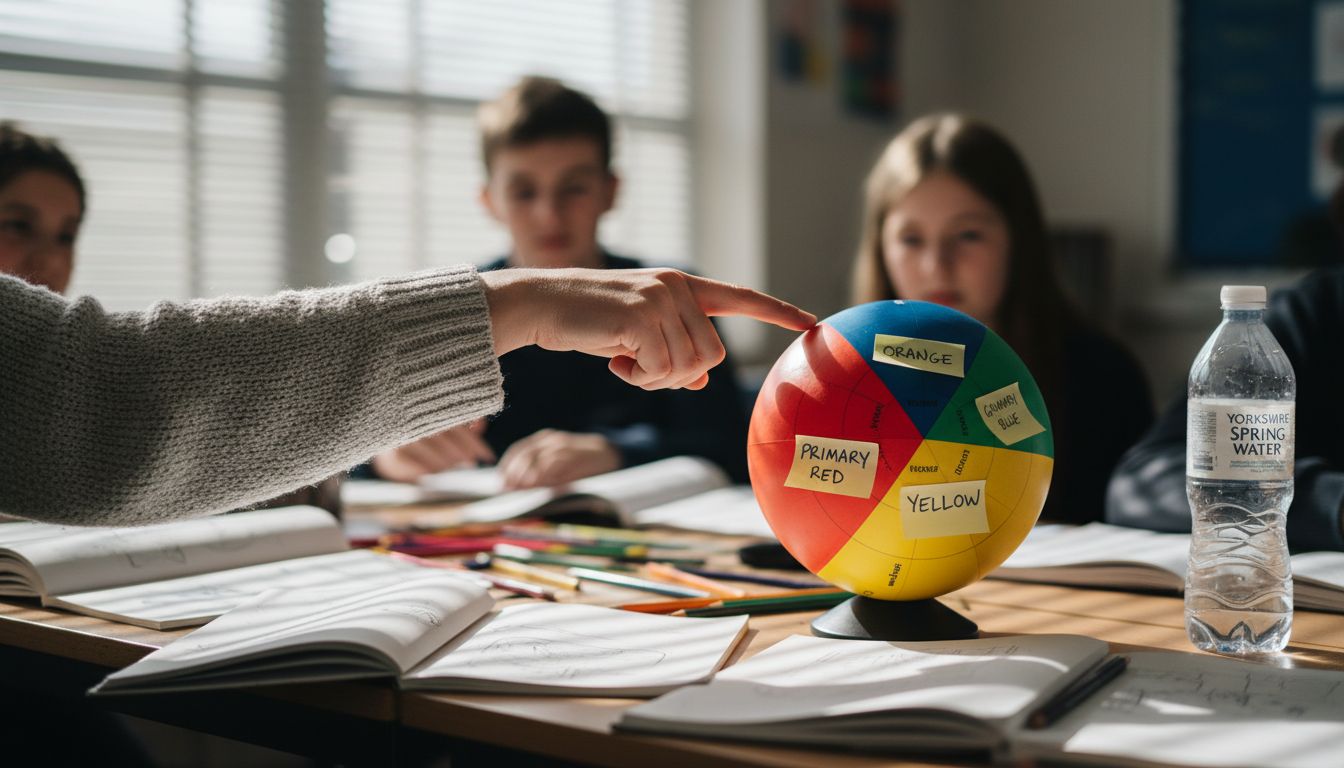
Tertiary colours represent the sophisticated intermediary zones where secondary colours blend, revealing complex chromatic relationships. Observe how these transitional hues create smooth gradients across the globe, demonstrating the intricate interconnectedness of colour families. By rotating the sphere, you will gain unprecedented insight into how colours communicate, overlap, and transform across spatial dimensions.
Step 4: Explore hue, value and chroma with the globe
Understanding the nuanced dimensions of colour requires a sophisticated approach that goes beyond simple visual perception. Your Kolormondo globe offers an extraordinary three dimensional platform for comprehending the complex interplay of hue, value, and chroma in ways traditional colour tools cannot match.
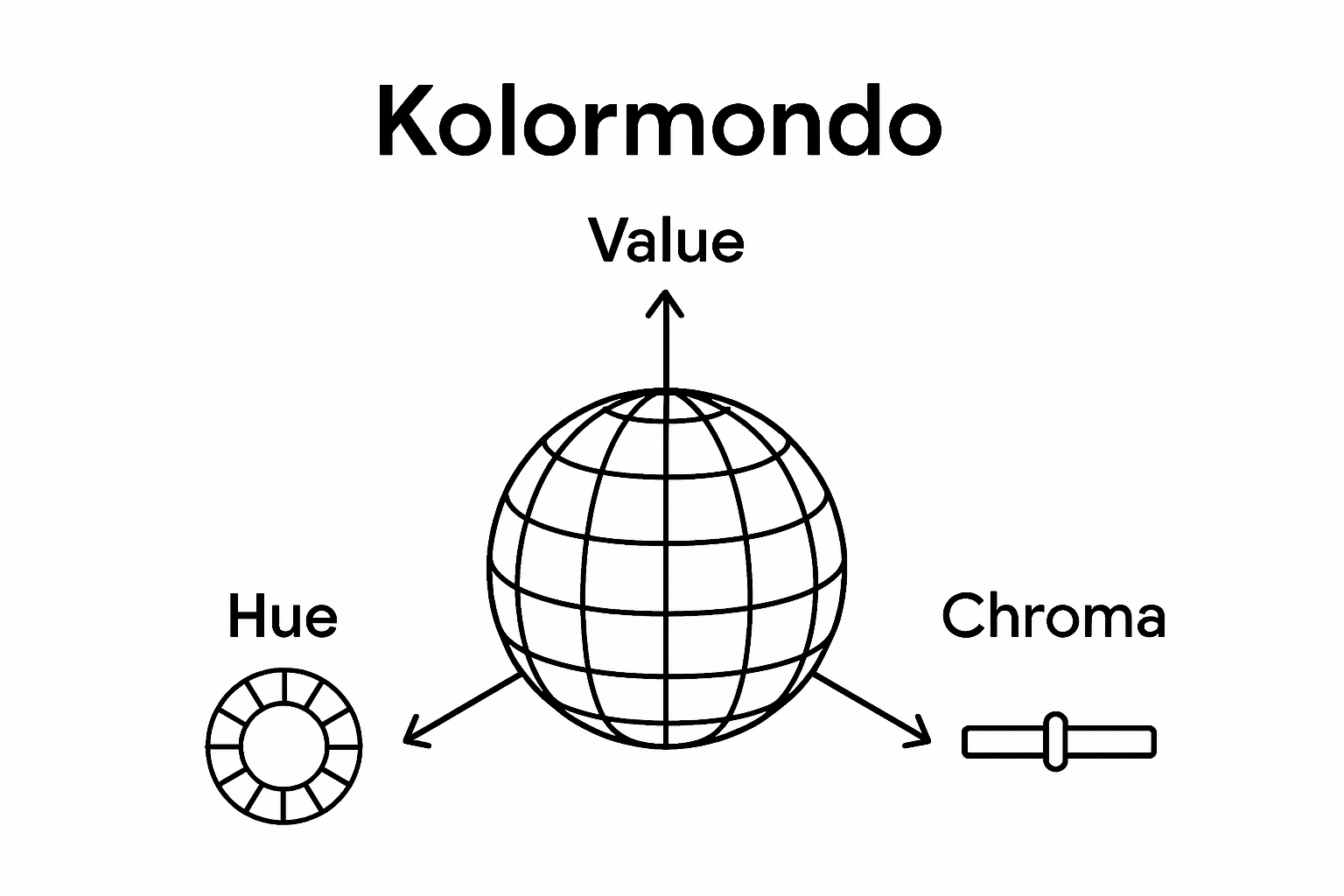
Begin by examining hue the fundamental characteristic that defines a colour’s essential identity. Rotate the globe to observe how different hues interact and blend, noting the subtle transitions between primary, secondary, and tertiary colours. Learning about colour reference techniques will help you appreciate the intricate relationships between different chromatic zones.
Value represents the lightness or darkness of a colour, which becomes strikingly apparent when you tilt and rotate the globe. Observe how colours shift from pale tints to deep shades, revealing their inherent luminosity. Chroma explores a colour’s intensity and purity, demonstrating how saturated hues relate to more muted variations. By systematically exploring these three dimensions, you will develop a profound understanding of colour’s spatial and perceptual complexity.
Step 5: Verify understanding by testing colour relationships
Critical learning emerges through active experimentation and deliberate practice. Your Kolormondo globe becomes a powerful instrument for testing and validating your comprehension of complex colour interactions, transforming theoretical knowledge into tangible understanding.
Develop targeted testing strategies by creating deliberate colour combinations and observing their relationships. Explore the role of colour theory in visual composition to ground your experiments in established principles. Challenge yourself by selecting seemingly disparate colours and rotating the globe to understand their underlying connections, tracking how proximity and angle influence perceived relationships.
Practical verification involves systematic observation and documentation. Select three colours and track their interactions across different rotational angles, noting how their perceived relationships shift. Record your observations in a dedicated colour journal, sketching the globe’s orientation and documenting your insights. This methodical approach will transform your passive observation into active learning, deepening your understanding of chromatic complexity.
Master Colour in 3D with Kolormondo’s Innovative Tools
Struggling to visualise complex colour relationships in your art or design projects? The Kolormondo globe offers a groundbreaking three dimensional solution that transforms abstract colour theory into tangible, spatial understanding. By exploring primary, secondary, and tertiary colours in a full sphere you gain deeper insight into hue, value, and chroma—key concepts highlighted in this guide. Whether you are an educator, student, or creative professional, enhancing your colour comprehension with a hands-on globe can unlock new creative possibilities.
Discover how the Kolormondo colour globe can revolutionise your learning and design process by visiting our Color Globe and color sphere - Kolormondo collection. For deeper educational support, explore our Educational material and lesson plans - Kolormondo. Don’t wait to enrich your palette and elevate your projects; visit https://kolormondo.com today and start your tactile journey into the vibrant world of 3D colour.
Frequently Asked Questions
How can I gather the essential tools for visualising colour in 3D?
To gather the essential tools for visualising colour in 3D, start by exploring both physical and digital options. For physical tools, consider using a three-dimensional colour wheel, while digital solutions can include open-source 3D graphics software. Aim to build a balanced toolkit that facilitates colour rotation and mixing for effective understanding.
What is the best way to set up my Kolormondo globe for effective colour exploration?
To set up your Kolormondo globe, choose a stable surface with uniform lighting at eye level for optimal viewing. Ensure the globe is positioned where it can rotate freely, and adjust the lighting to minimise glare, allowing you to observe colour interactions clearly from various angles.
How do I identify primary, secondary, and tertiary colours on the globe?
Begin by locating the primary colours—red, blue, and yellow—on your Kolormondo globe, each at equal distances from each other. Then, find secondary colours—green, orange, and purple—positioned between the primaries. Rotate the globe to discover tertiary colours created by blending secondary hues, facilitating a deeper understanding of colour relationships.
How can I explore hue, value, and chroma using the Kolormondo globe?
Explore hue by rotating the globe to observe how different colours interact, paying attention to the transitions between them. Tilt the globe to examine value as colours shift from light to dark, then assess chroma by comparing saturated hues against muted variations. Engage in this systematic exploration to grasp the complexities of colour.
What strategies can I use to verify my understanding of colour relationships?
Develop verification strategies by creating specific colour combinations and observing their interactions on the globe. Record your observations in a dedicated colour journal, detailing how colour relationships change with different angles and proximities. Actively engage with your findings to reinforce your understanding of colour dynamics.
Recommended
- Visualising Colour In 3D: A New Approach To Understanding
- 7 Key Colour Wheel Comparison List Tips for Art and Design
- The Role of Color in Architecture: A 3D Color Wheel Guide
- How to use Kolormondo
- Using Projector for Art: Creative Ideas and Tips 2025 - Projector Display
- How Light Affects Color: Complete Expert Guide
Find similar articles
how to visualize color in 3d
