

Most advice about colour theory overlooks how the average British artist or designer interacts with colour in daily life. Over 80 percent of professionals in visual fields admit they struggle to translate two-dimensional colour charts into real-world creativity. Understanding the 3D colour wheel opens up a fresh approach that goes beyond flat diagrams and brings colour relationships to life. This overview uncovers how three-dimensional models change the way colour is experienced and applied, offering practical insight for anyone serious about creative work.
Table of Contents
- Defining The 3D Colour Wheel
- Comparing 2D And 3D Colour Models
- Structure And Features Of The Kolormondo Globe
- Educational And Creative Applications Across Fields
- Common Misconceptions And Limitations
Key Takeaways
| Point | Details |
|---|---|
| 3D Colour Models Enhance Understanding | The 3D colour wheel provides deeper insights into colour relationships compared to 2D models, allowing for comprehension of hue, value, and chroma in a spatial context. |
| Practical Applications Across Disciplines | 3D colour wheels are valuable tools for graphic designers, interior designers, and educators, facilitating harmony in colour palettes and clearer demonstrations of colour theory. |
| Limitations of Colour Models | Despite their sophistication, 3D colour wheels cannot fully capture the complexities of human colour perception, necessitating a critical approach to their use in various professions. |
| Transformative Educational Tool | The Kolormondo globe revolutionises colour education, enabling students to interactively explore colour theory and its applications in real-world contexts. |
Defining the 3D Colour Wheel
A 3D colour wheel represents a revolutionary approach to understanding colour relationships that transcends traditional two-dimensional representations. Unlike flat colour charts, this three-dimensional model allows artists, designers, and students to comprehend colour interactions with remarkable depth and precision. Visualising colour in 3D provides an immersive understanding of how hues, values, and chromatic intensities interconnect.
At its core, a 3D colour wheel is a sophisticated spatial representation that maps colours across three critical dimensions: hue (the pure colour), value (lightness or darkness), and chroma (colour intensity). The learner.org research reveals that this model illustrates colour relationships far more comprehensively than traditional flat wheels, enabling users to understand nuanced colour interactions from multiple perspectives.
The structural complexity of a 3D colour wheel allows for unprecedented insights into colour theory. Imagine a spherical or globe-like model where colours are positioned not just in a circular arrangement, but with depth that represents variations in saturation and brightness. Designers can trace colour transitions, understand complementary relationships, and explore subtle chromatic shifts with a level of detail impossible in two-dimensional representations. This spatial approach transforms colour understanding from a flat concept to a dynamic, interactive experience that mirrors the rich complexity of visual perception.
Practical applications of 3D colour wheels span multiple creative disciplines. Graphic designers can leverage these models to create harmonious colour palettes, interior designers can predict colour interactions in spatial contexts, and artists can explore nuanced colour blending techniques with unprecedented precision. The master colour wheel blending guide provides additional insights into leveraging these advanced colour visualization techniques across professional creative practices.
Comparing 2D and 3D Colour Models
Traditional two-dimensional colour wheels have long been the standard tool for understanding colour relationships, presenting hues in a circular arrangement that reveals basic interactions between primary, secondary, and tertiary colours. These flat models offer fundamental insights but ultimately limit the complexity of colour perception to a single plane of understanding.
The key distinction between 2D and 3D colour models lies in their dimensional representation. Traditional 2D wheels map colours in a circular format, whereas 3D models introduce depth, allowing for a more nuanced exploration of colour attributes. This spatial approach enables designers and artists to comprehend colour not just as a flat spectrum, but as a dynamic, multifaceted system where hue, saturation, and brightness interact in complex ways. Exploring advanced colour visualization techniques reveals the profound limitations of two-dimensional representations.
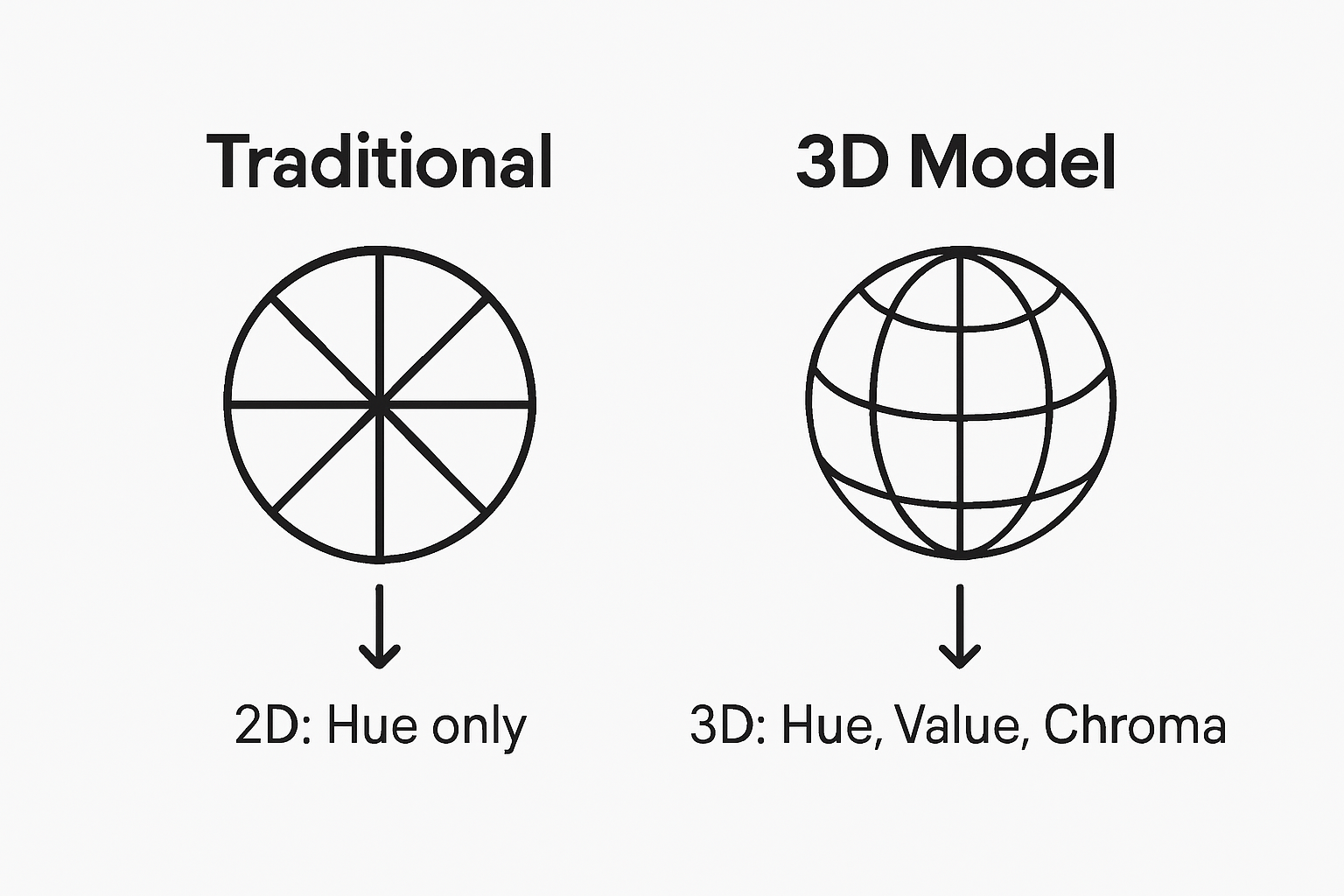
Where 2D colour wheels provide a basic framework for colour theory, 3D models offer a transformative perspective. Imagine a spherical model where colours are positioned with volumetric complexity, revealing subtle gradations and relationships impossible to perceive in flat charts. Artists can trace intricate colour transitions, understand complementary relationships with unprecedented precision, and explore chromatic variations that traditional models obscure. This three-dimensional approach mirrors the rich, layered nature of human visual perception.
Practical implications of this dimensional shift are significant across creative disciplines. Graphic designers can create more harmonious palettes, interior designers can predict spatial colour interactions more accurately, and painters can understand colour blending with remarkable depth. Colour wheel comparison strategies demonstrate how these advanced models are revolutionising our understanding of colour theory, transforming it from a static concept to a dynamic, immersive experience.
Structure and Features of the Kolormondo Globe
The Kolormondo globe represents a groundbreaking approach to colour visualization, transforming the traditional colour wheel into a sophisticated three-dimensional model. Comparing different colour reference tools reveals the unique structural innovations that set this colour globe apart from conventional representations.
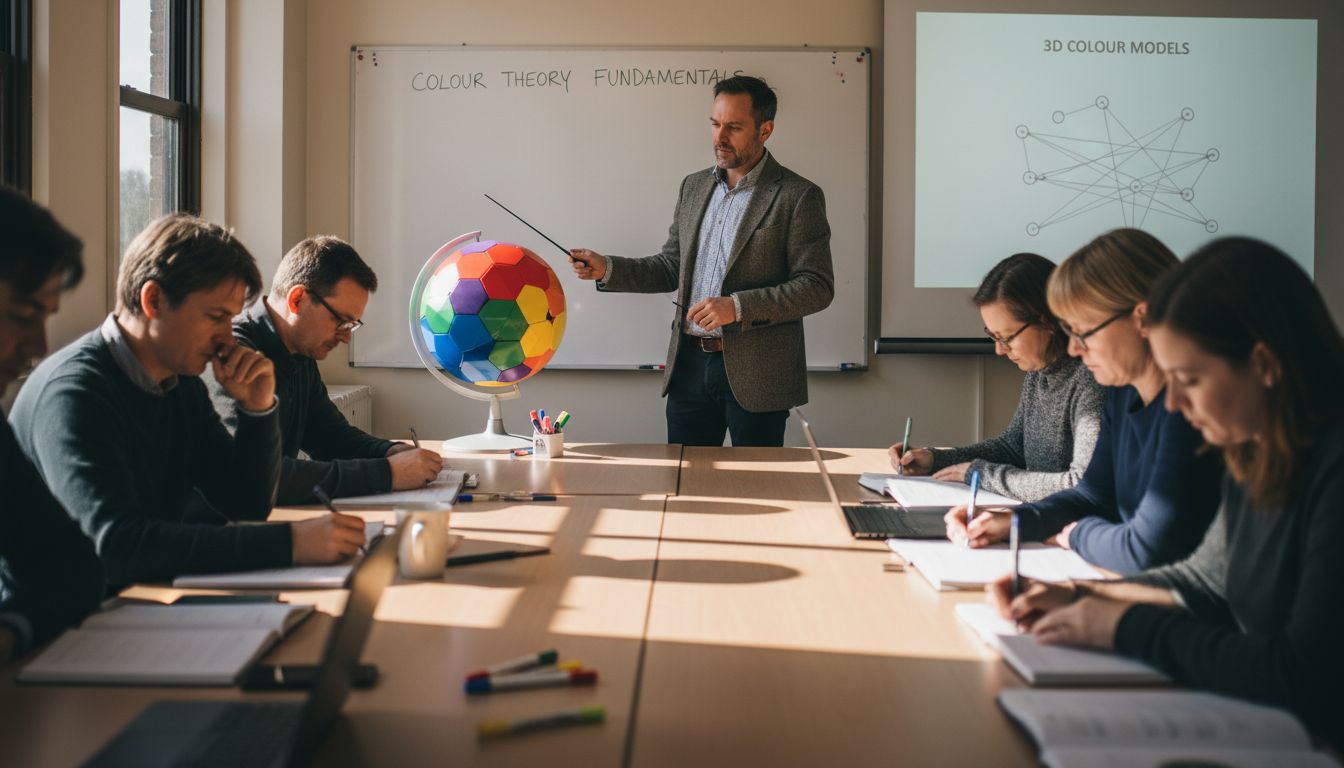
At its core, the Kolormondo globe is engineered with a precise spatial arrangement that maps colours across multiple dimensions. The spherical design enables users to explore colour relationships through depth, allowing for an intuitive understanding of how hues interact, blend, and transform. Understanding globe variations highlights the versatility of this colour visualization tool, with different models catering to various professional and educational needs.
The globe’s structural complexity is its primary strength. Unlike flat colour wheels, this three-dimensional model positions colours with remarkable precision, representing not just hue, but also saturation and brightness as spatial relationships. Designers, artists, and educators can rotate the globe, examining colour interactions from multiple angles, which provides insights impossible to achieve with two-dimensional representations. The tactile nature of the Kolormondo colour globes transforms colour theory from an abstract concept into a tangible, interactive experience.
Practical applications of the Kolormondo globe span numerous creative and professional domains. Interior designers can explore colour harmony, graphic artists can understand complex colour relationships, and educators can demonstrate colour theory with unprecedented clarity. The globe’s design allows for precise colour matching, understanding complementary relationships, and exploring nuanced chromatic transitions in a way that brings colour theory to life through a truly three-dimensional perspective.
Educational and Creative Applications Across Fields
The three-dimensional colour wheel has transformed educational approaches to understanding colour science, enabling students to develop complex models of light interaction and visual perception. By providing a tangible, interactive representation of colour relationships, this innovative tool bridges theoretical knowledge with practical understanding across multiple disciplines.
In art and design education, the 3D colour globe serves as a revolutionary pedagogical instrument. Students can explore colour theory with unprecedented depth, manipulating the globe to understand how hues interact, blend, and transform. Graphic design programmes, fashion academies, and visual arts curricula are increasingly incorporating these three-dimensional models to help learners comprehend sophisticated colour relationships that traditional flat wheels cannot effectively communicate.
Beyond artistic disciplines, the 3D colour wheel finds profound applications in scientific and technical fields. Researchers in optics, visual perception, and colour psychology utilise these models to demonstrate complex chromatic interactions. Architects and interior designers leverage the globe to understand spatial colour relationships, predicting how different hues will interact in three-dimensional environments. Exploring advanced colour visualization techniques reveals the tool’s versatility across professional domains.
The practical implications extend to numerous professional contexts. Textile designers can predict fabric colour interactions, digital media professionals can enhance colour grading techniques, and multimedia artists can develop more nuanced colour palettes. By transforming colour theory from an abstract concept to a tactile, interactive experience, the 3D colour globe empowers creative professionals to explore chromatic relationships with remarkable precision and depth.
Common Misconceptions and Limitations
Colour wheel models are powerful visual tools, but they are not without inherent limitations. Many individuals misunderstand the universal applicability of colour wheels, believing they function identically across all creative and technical domains. In reality, different colour models serve specific purposes, with variations like RGB for digital displays, RYB for painting, and CMYK for printing, each designed for unique contextual requirements.
One significant misconception surrounds the comprehensiveness of colour representation. Colour wheels have fundamental perceptual limitations that prevent them from capturing the full complexity of human colour vision. While these models provide essential frameworks for understanding colour relationships, they cannot fully represent nuanced variations in brightness, saturation, and subtle chromatic interactions that occur in real-world visual experiences.
Professionals must recognise that 3D colour wheels, despite their advanced design, are still representational models with inherent constraints. They offer sophisticated insights but cannot perfectly replicate the infinite subtleties of colour perception. Artists, designers, and scientists must approach these tools as guides rather than absolute definitive representations, understanding that colour is fundamentally a complex perceptual phenomenon that transcends any single diagrammatic representation.
Practical challenges emerge when practitioners attempt to apply colour wheel principles without critical understanding. Digital designers might find RGB colour models more precise for screen-based work, while painters rely on traditional RYB models. The key is recognising each model’s strengths and limitations, using them as complementary tools rather than universal solutions. Sophisticated colour professionals understand that these wheels are interpretative instruments, offering valuable insights while acknowledging the inherent complexity of colour perception.
Discover a New Dimension in Colour Learning with Kolormondo Globe
Understanding the complexity of colour theory can be challenging, especially when traditional 2D colour wheels fall short in representing the full spectrum of hue, value, and chroma. This article highlights how a 3D colour wheel solves common frustrations by offering a tactile, immersive experience that reveals the intricate relationships between colours from every angle. Whether you are an educator seeking engaging teaching tools or a designer needing precise colour harmony, the Kolormondo globe brings colour theory to life with unmatched clarity.
Elevate your creative process today by exploring our range of innovative Color Globe and color sphere - Kolormondo. Complement your learning with our specially crafted Educational material and lesson plans - Kolormondo that make 3D colour exploration accessible for all skill levels. Visit https://kolormondo.com now and transform the way you experience colour theory with our unique, hands-on globes designed for professionals and enthusiasts alike.
Frequently Asked Questions
What is a 3D colour wheel?
A 3D colour wheel is a sophisticated spatial representation of colours that maps them across three dimensions: hue, value, and chroma. It allows users to understand complex colour interactions far better than traditional 2D colour wheels.
How does a 3D colour wheel differ from a traditional 2D colour wheel?
The main difference lies in their dimensionality. A 2D colour wheel presents colours in a flat, circular format, whereas a 3D colour wheel incorporates depth, enabling a more nuanced exploration of colour attributes like saturation and brightness.
What are the practical applications of a 3D colour wheel?
3D colour wheels are beneficial across various creative disciplines, including graphic design, interior design, and art education. They help designers create harmonious palettes, predict colour interactions, and understand colour blending techniques with greater precision.
Are there any limitations to using a 3D colour wheel?
Yes, while 3D colour wheels offer advanced insights into colour theory, they still have perceptual limitations and cannot fully capture the complexities of human colour vision. They should be regarded as guides rather than absolute representations of colour relationships.
Recommended
Find similar articles
what is a 3d color wheel
